
Safeguarding and child protection policy
Reviewed by Designated Safeguarding Lead: Wendy Burton, DSL
Date: 3 August 2026
Approved by Safeguarding Proprietor: Amanda Trevor-Roberts and Simon Trevor-Roberts
Date: 28 August 2026
Approved by SLT:
26 August 2026
Next review: DSL
August 2027
1 Safeguarding Contact Details
2 Introduction
3 Principles
4 Roles and responsibilities
5 Key personnel
6 Staff training
7 Hierarchy of intervention
8 Early help and family help
9 What to look out for and when to be concerned
10 Wishes of the child
11 Contextual safeguarding
12 Signs of abuse
13 Listening to pupils and record keeping
14 Procedure to be followed by staff if they have concerns about a pupil’s welfare
15 Duties of the DSL on being notified of a concern about a pupil’s welfare
16 Making a referral to children’s social services
17 Informing parents
18 Arrangements for dealing with child-on-child abuse and allegations
19 Child-on-child sexual violence and sexual harassment
20 Digital safety
21 Allegations about members of staff, supply staff, contractors and volunteers
22 Low-level concerns
23 Other safeguarding arrangements
24 Monitoring this policy
25 Other relevant policies
Appendix 1: Other types of abuse
Appendix 2: Further information on signs of abuse
Appendix 3: Actions where there are concerns about a child (KCSIE, September 2024)
Appendix 4: Flowchart of when and how to share information
Appendix 5 Child Protection Expression of Concern Form
Appendix 6: DSL Job Description
Appendix 7: Hackett’s Continuum of Sexual Behaviours
| Position | Name | Phone | |
|---|---|---|---|
| Designated Safeguarding Lead (DSL) and EYFS Lead | Wendy Burton | 0207 586 1444 | w.burto1@trevor-robertsschool.co.uk |
| Deputy DSL | Gemma Fernandes | 0207 586 1444 | g.ferna4@trevor-robertsschool.co.uk |
| Headteachers | Simon Trevor-Roberts | 0207 586 1444 | trsenior@trevor-robertsschool.co.uk |
| Amanda Trevor-Roberts | 0207 586 1444 | trjunior@trevor-robertsschool.co.uk | |
| Safeguarding Proprietor | Amanda Trevor-Roberts | 0207 586 1444 | trjunior@trevor-robertsschool.co.uk |
| Online Safety Lead | Thomas Trevor-Roberts | 0207 586 1444 | t.trevo7@trevor-robertsschool.co.uk |
Local Authority children’s social services numbers |
|||
| Name | Phone | Out of hours phone | |
| MASH Education Lead Lucy Coull | 0207 974 3317 | LBCMASHadmin@camden.gov.uk | |
| Children’s Contact Service/MASH Team Manager, Tracey Murphy | 0207 974 1553/3317 | LBCMASHadmin@camden.gov.uk | |
| Camden Child Protection Service Manager, Kurt Ferdinand | 0207 974 6481 | ||
Allegations against staff |
|||
| Title | Name | Phone | |
| Local Authority's Designated Officer (LADO) | Jacqueline Fearon | 0207 974 4556 | LADO@camden.gov.uk |
Extremism |
|||
| Title | Name | Phone | |
| Local Authority Prevent Officer | Jane Murphy | 0207 974 1008 | jane.murphy@camden.gov.uk |
| DfE non-emergency advice | n/a | 020 7340 7264 | counter-extremism@education.gsi.gov.uk |
| Police Prevent Engagement Officer | 999 (101 non-emergency) | ||
Female Genital Mutilation (FGM) |
|||
| Title | Name | Phone | |
| Police | 999 (101 non-emergency) | ||
Other useful contact details |
|||
| Title | Name | ||
| Childline | 0800 1111 | ask@childline.org.uk | |
| NSPCC | 0808 800 5000 | help@nspcc.org.uk | |
| NSPCC Whistleblowing Advice Line | 0800 028 0285 | ||
| NSPCC Victims of Sexual harassment and abuse helpline | 0800 136 663 | ||
| Kidscape (Anti-bullying helpline for parents) | 0845 120 4881 | parentsupport@kidscape.org.uk | |
| Report Abuse in Education | 0800 136 663 | ||
| National Domestic Abuse Helpline | 0800 2000 247 | ||
| Child exploitation Online Prevent (CEOP) | 0870 000 3344 | ||
| Disclosure and Barring Service | 03000 200 190 | customerservices@dbs.gov.uk | |
| Teaching Regulation Agency | 0207 593 5393 | TRA.Caseworker@education.gov.uk | |
| Ofsted Safeguarding Children | 0300 123 4666 | 0300 123 4666 enquiries@ofsted.gov.uk |
|
2.1 Trevor-Roberts School is committed to safeguarding and promoting the welfare and wellbeing of young people and staff. We believe that everyone, without exception, has the right to be safe, to be treated with dignity and respect, and to live free from discrimination, regardless of background. The School recognises that children and young people learn best when they are healthy, safe and secure.
2.2 Safeguarding and promoting the welfare of children is defined as: providing help and support to meet the needs of children as soon as problems emerge; protecting children from maltreatment, whether that is within or outside the home, including online; preventing impairment of children’s mental and physical health or development; ensuring that children grow up in circumstances consistent with the provision of safe and effective care; and taking action to enable all children to have the best outcomes. Child protection is part of safeguarding and relates to activity that is undertaken to protect children who are suspected to be suffering, or likely to suffer, significant harm.
2.3 This policy applies to all pupils in the School, including those in the EYFS.
2.4 The purpose of this policy is to inform all staff (including supply staff and trainee teachers), parents (including guardians and carers), contractors, third parties, volunteers and governors about the School’s responsibilities for safeguarding children and to enable all parties to have a clear understanding of how these responsibilities should be carried out. It applies wherever staff members are working with pupils, even where this is away from the School, such as on educational visits or when delivering lessons online.
2.5 This policy is published on the School’s website and is also available to parents of current and prospective pupils from the Designated Safeguarding Lead (Wendy Burton w.burto1@trevor-robertsschool.co.uk) on request. Large print or other accessible formats can also be made available.
2.6 The policy is in accordance with the Camden Safeguarding Children Partnership’s agreed local interagency procedures.
2.7 This policy is also in accordance with current legislation and the following statutory guidance:
- Keeping Children Safe in Education (September 2026) [KCSIE]
- Working together to improve school attendance (July 2026)
- Working Together to Safeguard Children (March 2026) [WTSC]
- Prevent Duty Guidance for England and Wales (December 2023)
- Education (Independent School Standards) Regulations 2014
- Statutory framework for the Early Years Foundation Stage (September 2026)
- After school clubs, community activities and tuition (February 2026)
- What to do if you are worried a child is being abused – advice for practitioners (March 2015)
- Safeguarding children and young people (October 2018)
- Disqualification Under the Childcare Act (August 2018)
- Children Missing Education (September 2025)
- Relationships Education, Relationships and Sex Education and Health Education (September 2026)
- Digital and technology standards in schools (April 2026)
- The Equality Act (2010)
- The Human Rights Act (1998)
2.8 The School recognises its duties under the Equality Act 2010 and is committed to ensuring that no pupil is disadvantaged or discriminated against because of a protected characteristic (sex, race, disability, religion or belief, gender reassignment, pregnancy, maternity, or sexual orientation). In carrying out its safeguarding responsibilities, the School considers the additional needs and potential vulnerabilities of pupils with protected characteristics and makes reasonable adjustments where required. The School is committed to ensuring that all pupils can express their views and access support. Additional assistance will be provided where necessary, including for pupils with disabilities, communication needs, or for whom English is an additional language.
2.9 Effective safeguarding practice is anti-discriminatory and anti-racist. Staff understand that factors such as disability, ethnicity, culture, language, and social or economic circumstances may affect a child’s experiences and access to support. Staff are also alert to unconscious bias, including adultification bias, and take steps to ensure that all pupils receive appropriate protection and support.
2.10 We are advised by the Camden Safeguarding and Child Protection in Schools and Education Officer, whom the DSL regularly consults on safeguarding matters. Contact details can be found in section 1 of this policy.
2.11 Every complaint or suspicion of abuse from within or outside the School will be taken seriously and action will be taken in accordance with this policy.
Wendy Burton, DSL
3.1 Trevor-Roberts School expects all staff to share our commitment to safeguarding and promoting the welfare of all pupils in our care. To achieve this, the School seeks to create a safe School environment with a strong pastoral system, where pupils who have been subject to any form of abuse can report the matter, confident that it will be taken seriously, they will not be made to feel ashamed of making a report and will be fully supported. Staff are trained to listen to pupils’ concerns, identify issues early and respond appropriately following agreed procedures. The School will consider, at all times, what is in the best interests of the child.
3.2 The School will take all reasonable measures to:
- ensure that we practise safer recruitment in checking the suitability of staff (including staff employed by other organisations) to work with children and young people. Staff recruitment procedures are outlined in detail in the School’s Staff Recruitment Policy;
- follow the local inter-agency procedures of Camden Safeguarding Children Partnership and contribute to inter-agency working;
- support pupils in need through early intervention and, where appropriate, through the Early Help Assessment (EHA) process and coordinated multi-agency support arrangements.
- be alert to signs of abuse, both in the School and from outside and to protect each pupil from any form of abuse, whether from an adult or another pupil;
- deal appropriately with every suspicion or complaint of abuse and support pupils who have been abused in accordance with their agreed child protection plan;
- design and operate procedures which promote this policy, but which, so far as possible, ensure that staff who are the subject of unfounded, false or malicious allegations are treated fairly and are not prejudiced by them;
- be alert to the needs of pupils with physical and mental health conditions;
- operate robust and sensible health and safety procedures;
- operate clear and supportive policies on drugs, alcohol and substance misuse;
- assess the risk of children being drawn into terrorism, including support for extremist ideas that are part of terrorist ideology, based on an understanding of the potential risk in the local area;
- identify children who may be vulnerable to radicalisation, and know what to do when they are identified;
- take all practicable steps to ensure that the School premises are as secure as circumstances permit;
- teach pupils about safeguarding issues and about how to keep themselves safe (including online and when working from home online); and
- ensure that any deficiencies in our child protection and safeguarding procedures are remedied without delay.
4.1 Safeguarding and child protection are everyone’s responsibility. All staff (including trainee teachers, contractors and volunteers) are under a general legal duty to:
- contribute to providing a safe environment in which pupils can learn;
- consider at all times the best interests of the pupil and take action to enable all pupils to have the best outcomes;
- attend appropriate safeguarding and child protection training on an annual basis or additionally as directed by the DSL;
- be aware that children may not feel ready or know how to tell someone that they are being abused, exploited or neglected and that they may not recognise their experiences as harmful;
- be aware of the indicators of the different forms of abuse, neglect, exploitation, modern slavery, and of emergent mental health issues;
- assist children in need and protect children from abuse, neglect, radicalisation and extremism;
- be familiar with the School’s policies pertaining to safeguarding and child protection procedures and follow them;
- know how to access and implement the procedures, independently if necessary;
- keep a sufficient record of any significant complaint, conversation or event;
- report any matters of concern to the DSL or, where appropriate, to one of the key contacts in accordance with this policy; and
- support social services and any other agencies following any referral.
4.2 The Designated Safeguarding Lead (DSL)
The School has appointed a Designated Safeguarding Lead (DSL), who is a senior member of staff and a member of the School’s leadership team, with the status, authority, training, skills and experience necessary to fulfil the responsibilities of the role. The DSL takes lead responsibility for safeguarding, including online safety, and child protection and is the first point of contact for parents, pupils, staff and others if they have any concerns about safeguarding or child protection. The School also has Deputy DSLs, so that an appropriately trained and designated person is available whenever the School is open.
The DSL will be given the time, funding, training, resources and support to ensure they are able to fulfil all the key aspects of their role as described in KCSIE (Sept 2026):
- Managing Referrals: the DSL will manage the referral of cases of suspected abuse, neglect, exploitation, radicalisation or any other relevant issue to the Local Authority Social Care Service, Channel programme, DBS and/or Police as appropriate.
- Working with others: the DSL will be the principal point of contact for all staff and when co-ordinating different departments and functions within and outside the School in the management of a case. They will promote supportive relationships with parents and carers to safeguard pupils’ welfare, be able to identify the causes and consequences of issues that children are experiencing and to support staff to make appropriate adjustments in the provision of educational programmes.
- Information sharing and managing the child protection file: the DSL is responsible for keeping child-protection files up to date with accurate and complete records of any actions or decisions taken, the rationale for these decisions and ensuring these confidential records are securely stored and, where appropriate, transferred to a new school promptly.
- Raising Awareness: the DSL is responsible for reviewing and updating the School’s safeguarding policy at least annually, for ensuring that all staff members have had appropriate training regarding its implementation, and that parents can access the policy and know that the School may make referrals where abuse, neglect or exploitation is suspected.
- Training, knowledge and skills: the DSL will receive the appropriate level of training, together with regular updates, to ensure they understand the unique risks associated with online safety, are confident that they have the relevant knowledge and up-to-date capability required to keep children safe while they are online at school, and can diagnose and respond to the specific needs of vulnerable children and work effectively with agencies such as the LADO, the Police and the Channel programme.
- Providing support to staff: the DSL should receive sufficient support and training so that they can support staff and help them feel confident on welfare, safeguarding and child-protection matters, including referrals and taking into account safeguarding, welfare and SEN in the provision of academic and pastoral support.
- Understanding the views of children: the DSL should, through training, develop the knowledge and skills needed to encourage a culture of listening to children and taking account of their wishes and feelings among all staff. They should promote an understanding of the difficulties that children may have in approaching staff about their circumstances and help staff consider how to build trusted relationships which facilitate communication.
Note: A full description of the responsibilities of the DSL is set out in Appendix 5 of this policy.
4.3 Deputy Designated Safeguarding Leads (DDSL)
The DDSL is trained to the same standard as the DSL and, in the absence of the DSL, carries out those functions necessary to ensure the ongoing safety and protection of pupils. In the event of a long-term absence of the DSL, the DDSL will assume responsibility for all the activities described above. On a day-to-day basis safeguarding activities may be delegated to a DDSL but final lead responsibility for safeguarding and child protection remains with the DSL.
4.4 Head Teacher
The Head Teacher is responsible for ensuring that the procedures outlined in this policy are followed on a day-to-day basis. To this end the Head Teacher will ensure that:
- the safeguarding and child protection policy and procedures are implemented and followed by all staff;
- sufficient time, training, funding, support and resources necessary to enable the DSL and DDSLs to carry out their roles effectively are allocated, including the assessment of pupils and attendance at strategy discussions and other necessary meetings;
- matters which affect pupil welfare are adequately risk-assessed by appropriately-trained individuals and for ensuring that the relevant findings are implemented, monitored and evaluated;
- systems which operate with the best interests of the pupil at heart are in place for pupils to express their views and give feedback;
- all staff feel able to raise concerns about poor or unsafe practice and that such concerns are handled sensitively and in accordance with the School’s Whistleblowing Policy and low-level concerns procedures;
- pupils are provided with opportunities throughout the curriculum to learn about safeguarding, including keeping themselves safe online;
- safer recruitment procedures are being adhered to in line with Part 3 of KCSIE, September 2026;
- acts as the ‘case manager’ in the event of concerns and allegations of abuse made against another member of staff (including supply staff, trainee teachers and volunteers) and liaises with the Local Authority Designated Officer (LADO); and
- notifies the Disclosure and Barring Service and, where appropriate, the Teaching Regulation Agency and/or the Police of anyone who has harmed or may pose a risk to a child.
4.5 Safeguarding Proprietor
Amanda Trevor-Roberts is the nominated Safeguarding Proprietor who takes lead responsibility for monitoring the operation of safeguarding arrangements in the School. This is done in a number of ways, these being:
- conducting discussions about safeguarding matters with the DSL at least once a term and more regularly, if needed;
- liaising with the local authority and/or partner agencies where appropriate; and
- conducting an annual audit of the School’s safeguarding procedures and submitting the audit to the Proprietors with recommendations for further improvements. The annual audit will typically consider: the effectiveness and implementation of relevant policies; staff safeguarding training; staff recruitment procedures; management of the SCR; the handling of safeguarding issues; referral management; the contribution the School is making to inter-agency working; and the provision for teaching pupils how to keep themselves safe.
4.6 The Proprietors
The Proprietors have overall responsibility for ensuring compliance with child protection statutory requirements and actively promote the wellbeing of pupils. It is the role of the Proprietors to provide scrutiny of the safeguarding policy and safeguarding practice. The Proprietors take seriously its responsibility to fulfil its duty of care in promoting the welfare of children, ensuring their security and protecting them from harm. To this end, the Proprietors will ensure that:
- they facilitate a whole-school approach to safeguarding, ensuring safeguarding and child protection underpin all aspects of policy and procedure development.
- an effective, up-to-date safeguarding and child protection policy is in place that is clear and easy to understand for staff, pupils, parents and carers and is made available on the School’s website;
- other policies, as prescribed in Part 2 of KCSIE, are in place and operational;
- the obligations imposed by the Human Rights Act (1998) and the Equality Act (2010) are met;
- pupils are being taught about how to keep themselves and others safe, including online and that there is appropriate provision for the specific needs and vulnerabilities of individual children, including those who are victims of abuse and/or have SEN/D needs;
- required pre-employment checks are being carried out in a timely way and correctly recorded in the Single Central Register;
- an appropriate member of staff from the School’s leadership team is appointed to the role of DSL;
- all staff receive safeguarding induction and ongoing training in accordance with this policy;
- the School’s safeguarding arrangements take into account the procedures and practice of the Camden Safeguarding Children Partnership;
- the School contributes to inter-agency working, including providing a co-ordinated offer of early help (community-based or the targeted early help level of Family Help) when additional needs of pupils are identified;
- clear systems and processes are in place for identifying and managing pupils with mental health problems;
- child protection files are maintained and, where appropriate, such records are transferred to a pupil’s new school or School in accordance with statutory guidance;
- appropriate filters and monitoring systems are in place to keep children safe online and that these are reviewed annually;
- the School reports to the Camden Safeguarding Children Partnership any pupil who joins or leaves the School at non-standard transition times in line with statutory and local authority guidance.
4.7 The contact details for the Safeguarding Proprietor are set out in Section 1 of this policy.
5.1 The DSL at the School is Wendy Burton who is also the School Administrator. If the DSL is unavailable, the role will be carried out by one of the Deputy DSLs: Gemma Fernandes or Amanda Trevor-Roberts. The DSL or Deputy DSLs are always available when the School is open to discuss safeguarding concerns with staff, either in person or via telephone, email or a Google Meet.
5.2 Outside School hours and during out-of-term activities, any member of the SLT can be contacted by email.
5.3 The Prevent Lead is Wendy Burton
5.4 Wendy Burton oversees safeguarding within the EYFS and is the designated member of staff who oversees the welfare of looked after children.
5.5 Contact details for all the above are contained in section 1 of this policy.
6.1 Staff training encourages all members of staff to maintain an attitude of ‘it could happen here’ where abuse and neglect are concerned.
6.2 Induction training for all new members of staff, including temporary employees or volunteers, includes formal child-protection training which covers:
- This Safeguarding Policy and related policies on Anti-Bullying and Cyber-bullying, E-Safety, Mental Health and Prevent*;
- Part 1 and Annex A (Further information) of KCSIE*;
- the role, identity and contact details of the DSL and Deputy DSLs;
- policies on acceptable use of IT and online safety (including when they are online at home)*;
- the expectations, roles and responsibilities of staff in relation to filtering and monitoring online content;
- the pupil behaviour policy*;
- harmful sexual behaviours;
- the School’s safeguarding response to pupils who are absent from education, particularly on repeat occasions and/or for prolonged periods or children missing from education;
- the Staff Code of Conduct, including low-level concerns procedures*;
- the School’s policy on Whistleblowing*; and
- an overview of the Camden Safeguarding Children Partnership procedures.
* Copies of these documents will be provided either in paper form or electronically as part of the induction process and new staff will be required to sign a declaration confirming they have read and understood them. A proportional, risk-based approach will be taken to determine the level of information provided to temporary staff and volunteers.
6.3 All staff, including the Head Teacher and volunteers involved in regulated activity, will undertake appropriate child- protection training which, in line with Camden Safeguarding Children’s Partnership guidance, is updated annually. In addition, all staff will receive safeguarding updates delivered through a combination of regular staff meetings and the annual all staff training. Safeguarding training is coordinated by the DSL and includes online safety and Prevent training, where appropriate.
6.4 All staff receive updated copies of the School policies referred to above and are required to confirm that they have read and understood them. All staff must read Part 1 of KCSIE. Annex A, which contains further information, will be provided or signposted where relevant to staff roles, responsibilities, safeguarding risks or training needs. These materials are reissued to staff whenever the statutory guidance is updated by the DfE. Staff training provides an opportunity to check and consolidate their understanding of the policies. Staff can also access the policies and further reading in the staff section of the School’s Google drive.
6.5 The DSL team will regularly assess the appropriate level and focus for staff training so that it can respond to specific safeguarding concerns such as mental health, child-on-child abuse, online safety, radicalisation, child sexual exploitation, child criminal exploitation, sexual violence and harassment, prejudice-based and discriminatory bullying, and female genital mutilation.
6.6 All EYFS staff are required to attend safeguarding training specifically designed for staff caring for children aged 0-5 year olds which must cover all the areas set out in Annex C to the EYFS Statutory Framework: “Criteria for effective safeguarding training.” Training must be renewed at least every two years and all staff are required to attend. EYFS staff are supported to put their training into practice via regular updates and reminders from the DSL and inset training sessions.
6.7 The DSL and Deputy DSLs undertake training that is in accordance with locally agreed procedures to provide them with the knowledge and skills necessary to carry out their role. This training includes Prevent awareness training and will be updated every two years. Additional specialist training will be obtained for those who have specific responsibility for EYFS and looked after children. They also refresh their knowledge and skills at regular intervals (and at least annually) by following developments in safeguarding to:
- keep abreast of best practice for promoting a culture of listening to children;
- remain up to date on the mechanics of inter-agency working as operated by the LSCP;
- understand the assessment process for providing family help and statutory intervention, for example through locally agreed common assessment processes such as early-help assessments;
- have an up-to-date working knowledge of how local authorities conduct child-protection case conferences so they can contribute to these effectively when required to do so;
- be alert to the specific needs of children in need, those with special educational needs and disabilities, those with relevant health conditions and young carers;
- understand and support the School regarding the requirements of the Prevent duty and provide advice and support to staff on protecting children from the risk of radicalisation;
- remain up to date with AI-related risks, including the creation and sharing of AI-generated intimate imagery, use of AI tools for the purposes of grooming or exploitation of children; and
- be able to keep proper written records of concerns and referrals.
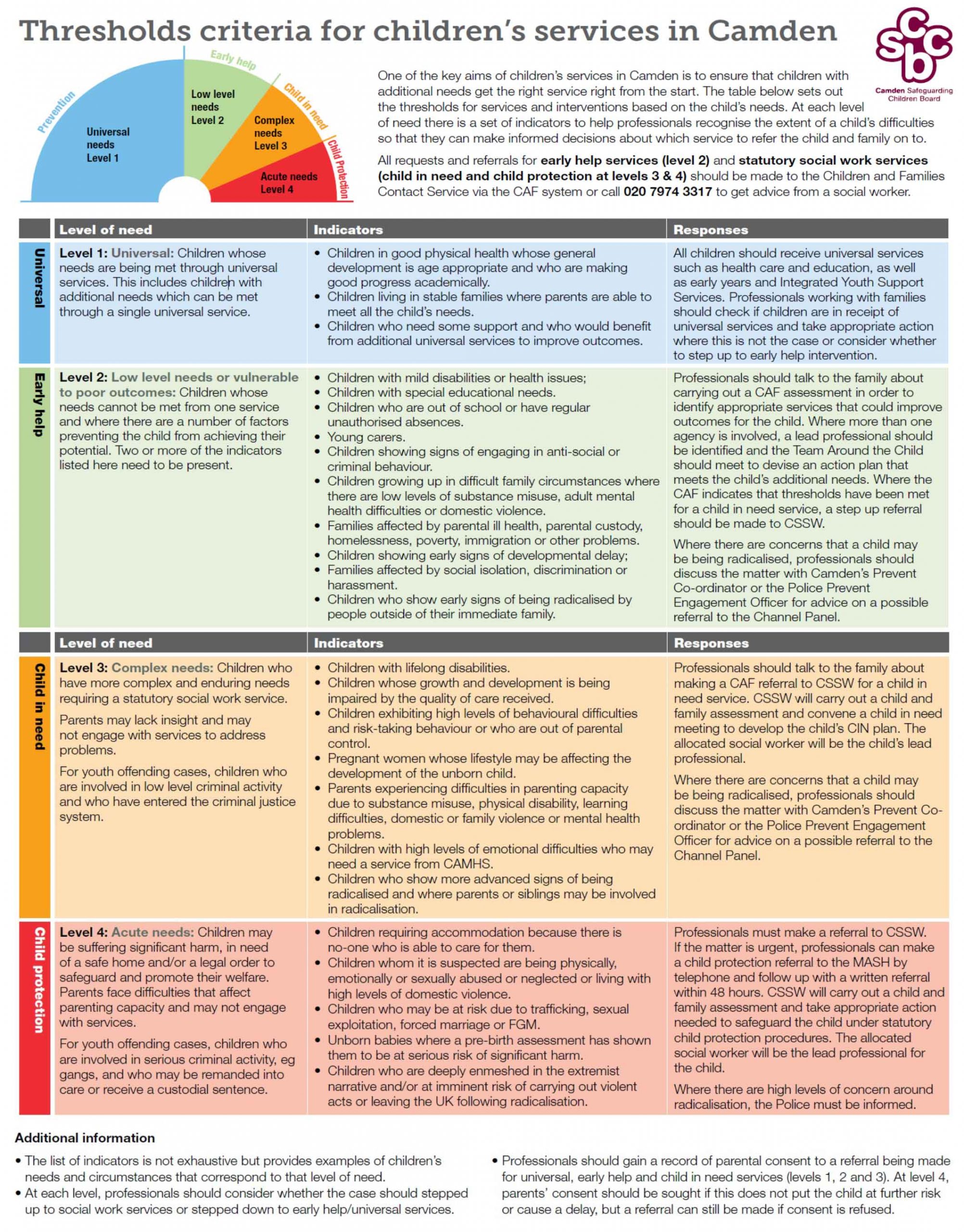
7.1 The Camden Safeguarding Children Partnership publishes threshold guidance Camden Threshold Guidance that all agencies, professionals and volunteers in the local authority can use to consider how best to meet the needs of individual children and young people. This guidance provides a summary of thresholds for intervention in relation to a continuum of need, ranging from children who need no additional intervention to those who require intensive help and specialist support. Children’s needs are not static and they may experience different needs – at different points on the continuum – throughout their childhood years.
7.2 Within the continuum, there are four levels of intervention:
8.1 We recognise that young people may face a range of challenges and ensure that staff are alert to those who need support. These include: stress, peer pressure, body image concerns, mental health and relationship issues. Pupils are encouraged to raise concerns as soon as they are identified, either through their form teacher, any member of staff they feel comfortable speaking with or directly to the Designated Safeguarding Lead, so that effective early support can be provided.
8.2 The School recognises the increased vulnerability of young people who:
- are disabled or have Special Educational Needs (whether or not they have a statutory Education, Health and Care plan) as they are more prone to peer-group isolation or bullying (including prejudice-based bullying);
- have a mental health need;
- do not have English as a first language;
- are living away from home for the first time;
- are frequently missing from care or home or persistently absent from School or not receiving full-time education;
- have been repeatedly removed from the classroom, experienced multiple suspensions, is on a part-time timetable, or is at risk of being permanently excluded from school;
- have exhibited early signs of abusive, violent and/or harmful behaviours;
- are faced with challenging family circumstances;
- are pregnant and or are parents themselves;
- are showing signs of being drawn into anti-social or criminal behaviour;
- are looked after children;
- are acting as a young carer;
- are misusing drugs or alcohol themselves;
- are at risk of being radicalised or exploited;
- are gender questioning;
- are showing early signs of abuse, neglect or mental health problems; and
- may be subject to discrimination and maltreatment on the grounds of race, religion, ethnicity, sexual orientation or sexual identity.
Such children may be more likely to need early help. Also, recognising abuse, neglect or exploitation may be more difficult for these young people for many reasons, including:
- assumptions that indicators of possible abuse such as behaviour, mood or injury relate to a pupil’s disability without further exploration;
- more prone to peer group isolation or bullying than other children;
- pupils with Special Educational Needs or Disabilities (SEN/D) can be disproportionately impacted by bullying/child-on-child abuse without outwardly showing any signs;
- communication barriers and difficulties overcoming these barriers;
- the need for intimate care and increased likelihood or a dependency on adults for support;
- cognitive understanding – being unable to understand the difference between fact and fiction in online content and then repeating the content/behaviours in the real world; and
- a disabled pupil’s understanding of abuse.
8.3 Early help refers to support provided through universal, community-based and school-based services where a child or family would benefit from additional help before statutory intervention is required. This may include support from pastoral staff, tutors, health professionals, counselling services, attendance support, family support services or other local provision. Trevor-Roberts School recognises the importance of providing early help to pupils to provide support for a problem as soon as it arises, to prevent it from escalating.
Where a child’s or family’s needs are complex, persistent or require coordinated multi-agency support, the School will consider whether targeted family help is appropriate, in line with local safeguarding partnership arrangements. Targeted family help brings relevant agencies together to assess need, agree a family-focused plan, identify a lead practitioner where appropriate, and provide coordinated support to improve outcomes for the child and family. Staff will work with parents, carers and partner agencies, where it is safe and appropriate to do so, to identify emerging needs, complete or contribute to early help or family help assessments, review the effectiveness of support, and escalate concerns without delay where risk increases or outcomes do not improve.
8.4 If staff believe that a pupil could benefit from early help, they should discuss the matter with the DSL who will, taking into account the Camden threshold criteria, consider what action should be taken.
8.5 Where early help or family help is provided, the School will keep the child’s situation under regular review. Support will be escalated without delay where the child’s needs are not being met, where outcomes are not improving, where parents or carers do not engage with support, or where there is evidence that the child may be suffering, or is likely to suffer, significant harm.
8.6 The School has various mechanisms to help identify emerging problems, including the School’s pastoral system, the PSHE programme and various policies, including the Anti-Bullying Strategy, ICT and Online Safety Policy and Acceptable Use Agreement. Staff training also prepares staff to identify pupils who might benefit from early help.
9.1 All staff should be aware of the types and signs of abuse, neglect and exploitation so that they are able to identify pupils who may be in need of help or protection. They also must be mindful that children may not feel ready or know how to tell someone that they are being abused, exploited, or neglected, and/or may not recognise their experiences as harmful. To reduce barriers to a potential disclosure staff must build trusted relationships with children which facilitate communication. Staff must also exercise professional curiosity and speak to the DSL if they have concerns.
9.2 Child abuse is a form of maltreatment of a child. Somebody may abuse or neglect a child by inflicting harm or by failing to act to prevent harm. Harm can include ill treatment that is not physical as well as witnessing the impact of the ill-treatment of others. This can be particularly relevant, for example, in relation to the impact on children of all forms of domestic abuse, including where they see, hear or experience its effects. Children may be abused in a family or in an institutional or community setting by those known to them or, more rarely, by others. Abuse can take place wholly online, or technology may be used to facilitate offline abuse. Children may be abused by an adult or adults or by another child or children (child-on-child abuse). Bullying, including cyberbullying, can cause significant harm and may constitute child-on-child abuse. Children may also cause harm to other family members, often referred to as child-to-parent or caregiver abuse. Where bullying causes, or is likely to cause, significant harm, it will be treated as a safeguarding and child protection concern.
9.3 Staff should be aware of the four main categories of child abuse which are commonly identified:
- Physical abuse: a form of abuse which may involve hitting, shaking, throwing, poisoning, burning, scalding, drowning, suffocating or otherwise causing physical harm to a child. Physical harm may also be caused when a parent or carer fabricates the symptoms of, or deliberately induces, illness in a child.
- Emotional abuse: the persistent emotional maltreatment of a child such as to cause severe and adverse effects on the child’s emotional development. It may involve conveying to a child that they are worthless or unloved, inadequate, or valued only insofar as they meet the needs of another person. It may include verbal abuse, such as persistent criticism, belittling, not giving the child opportunities to express their views, deliberately silencing them or ‘making fun’ of what they say or how they communicate. It may feature age or developmentally inappropriate expectations being imposed on children. These may include interactions that are beyond a child’s developmental capability as well as overprotection and limitation of exploration and learning, or preventing the child participating in normal social interaction. It may involve seeing or hearing the ill-treatment of another. It may involve serious bullying (including cyber-bullying), causing children frequently to feel frightened or in danger, or the exploitation or corruption of children. Some level of emotional abuse is involved in all types of maltreatment of a child, although it may occur alone.
- Sexual abuse: involves forcing or enticing a child or young person to take part in sexual activities, not necessarily through a high level of violence, whether or not the child is aware of what is happening. The activities may involve physical contact, including assault by penetration (for example rape or penetration with an object) or non-penetrative acts such as masturbation, kissing, rubbing and touching outside of clothing. They may also include non-contact activities, such as involving children in looking at, or in the production of, sexual images, watching sexual activities, encouraging children to behave in sexually inappropriate ways, or grooming a child in preparation for abuse. Sexual abuse can take place online, and technology can be used to facilitate offline abuse. Sexual abuse is not solely perpetrated by adult males. Women can also commit acts of sexual abuse, as can other children. The sexual abuse of children by other children is a specific safeguarding issue (also known as child-on-child abuse) and is covered in greater detail later in this policy (section 20).
- Neglect: the persistent failure to meet a child’s basic physical and/or psychological needs, likely to result in the serious impairment of the child’s health or development. Neglect may occur during pregnancy as a result of maternal substance abuse. Once a child is born, neglect may involve a parent or carer failing to: provide adequate food, clothing or shelter (including exclusion from home or abandonment); protect a child from physical and emotional harm or danger; ensure adequate supervision (including the use of inadequate care-givers); or ensure access to appropriate medical care or treatment. It may also include neglect of, or unresponsiveness to, a child’s basic emotional needs.
9.4 Other forms of abuse which staff should be aware of are:
- Children absent or missing from education
- Child sexual exploitation (CSE)
- Child criminal exploitation (CCE)
- County lines
- Domestic abuse
- Honour-Based Abuse (HBA) and Female Genital Mutilation (FGM)
- Forced marriage
- Radicalisation
- Child-on-child
- Sexual violence and harassment (including upskirting)
Further information is provided in Appendices 1 and 2 of this policy and in Part 1 and Annex A of KCSIE.
Where a safeguarding concern is identified, the School will take the child’s wishes and feelings into account when determining what action to take and what services and support should be provided. This is particularly important in cases involving child-on-child abuse, including sexual harassment, sexual violence and harmful sexual behaviour.
The School will ensure that pupils are able to raise safeguarding concerns through trusted, well-publicised, accessible and age-appropriate reporting mechanisms. Pupils will be supported to express their views and give feedback and will be reassured that all concerns and disclosures will be taken seriously, listened to and acted upon appropriately.
The School adopts a child-centred approach to safeguarding. Safeguarding decisions will be made in the best interests of the child and with due regard to the child’s wishes and feelings, taking account of their age, understanding and developmental needs. Whilst the School is committed to working openly and collaboratively with parents and carers wherever possible, the welfare of the child will always be the paramount consideration.
All staff should be aware that children may be vulnerable to abuse, exploitation or other safeguarding risks in contexts outside the home, including within peer groups, educational settings, the wider community and online. Extra-familial harms take a variety of different forms and children can be vulnerable to multiple harms including sexual abuse (including harassment and exploitation), domestic abuse in their own intimate relationships (teenage relationship abuse, including physical, sexual, emotional abuse, and stalking), criminal exploitation (including financial exploitation), serious youth violence, county lines and radicalisation.
When considering safeguarding concerns, incidents or behaviours, staff, and in particular the Designated Safeguarding Lead and any deputies, should consider the context in which they occur and whether environmental factors may be contributing to a risk of harm. This is known as contextual safeguarding.
As part of any assessment, the School will consider whether such contextual factors are present and, where a referral to Children’s Social Care or other agency is required, will share all relevant information to support a full and informed assessment of risk and need.
12.1 All staff need to be aware that pupils may be reluctant to report abuse generally, and particularly so about child-on-child abuse, and therefore need to be vigilant for potential indicators that abuse may be taking place and talk to Wendy Burton, the DSL or Gemma Fernandes, DDSL regarding any concerns they might have.
12.2 Possible indicators include, but are not limited to:
- a pupil disclosing abuse or neglect, or providing information that gives rise to a safeguarding concern;
- unexplained, inconsistent or recurring injuries, or injuries with unusual patterns or locations;
- frequent injuries or implausible explanations for injuries;
- sudden or significant changes in behaviour, presentation or emotional wellbeing;
- extreme, challenging, aggressive or withdrawn behaviour;
- anxiety, low mood, self-harm or expressions of hopelessness;
- poor attendance, repeated absences, missing episodes or reluctance to attend school;
- a deterioration in academic performance or engagement;
- apparent neglect, including poor hygiene, inadequate clothing, hunger, tiredness or unmet medical need;
- reluctance to return home or indications of difficulties within the family environment;
- delayed emotional, social or physical development;
- withdrawal from trusted adults, peers or previously enjoyed activities;
- flinching, fearfulness or an apparent reluctance to be touched;
- unexplained weight loss or gain;
- age-inappropriate sexualised behaviour, language or knowledge;
- unexplained gifts, money, possessions or association with older individuals;
- alcohol or substance misuse.
12.3 Further guidance is provided in Appendix 2. Other sources of information on the signs of abuse include: the DfE advice noteWhat to do if you’re worried a child is being abused (2015) and the NSPCC website.
13.1 The School provides a range of opportunities for pupils to be listened to. Pupils can speak with form teachers, any member of staff or the DSL team. Contact details for external agencies such as Childline & NSPCC are available on notice boards.
13.2 If a pupil discloses that they have been abused, neglected or harmed in some way, the member of staff should:
- immediately stop any other activity to listen;
- listen carefully to the pupil and keep an open mind and do not interrupt or be afraid of silences;
- keep in mind that some pupils may face additional barriers to telling someone because of their vulnerability, disability, sex, ethnicity, and/or sexual orientation;
- limit the questioning to the minimum necessary for clarification using “what, when, how, where” but avoiding leading questions (such as, “has this happened to your siblings?”) that may prejudice an investigation;
- not make any attempt to investigate the incident themselves or make a decision as to whether or not the pupil has been abused;
- reassure the pupil, but never promise not to tell anyone. Instead, explain who has to be told to ensure that proper action is taken in accordance with this policy;
- discuss the conversation with the DSL as soon as possible, and take no further action unless instructed to do so by the DSL or the Head Teacher;
- only share information on a need-to-know basis; and
- make a full written record of the conversation as set out below.
13.3 Staff must TALK TO THE DSL OR DDSL WHO WILL record in writing all concerns, discussions and decisions made about a pupil as soon as possible. The recording must be a clear, precise and factual account of the conversation or observations. Where a child has made a disclosure, the record must include details of:
- the date, time and place of the disclosure or concern;
- what was said and done, by whom and in whose presence; and
- any noticeable non-verbal behaviour or words used by the child.
The record should be signed by the person making it, using names, not initials. Any other evidence (for example, scribbled notes, mobile phones containing text messages, clothing, computers) must be kept securely and passed on to the DSL as soon as possible. No copies should be retained by the member of staff or volunteer.
Where a report includes an online element, staff should, where possible, avoid viewing illegal images of a child and under no circumstances should such images be forwarded electronically. Further guidance is available on what to do if viewing an image is unavoidable on:
https://www.gov.uk/government/publications/searching-screening-and-confiscation
14.1 If a member of staff has concerns about a pupil’s welfare, including any mental health concerns, they must inform the DSL or DDSL as soon as possible, unless the concerns involve an allegation against a member of staff, in which case the procedures set out in the section Allegations against members of staff (including supply staff, trainee teachers, contractors and volunteers)below should be followed. Staff should not assume that somebody else will act and share information that might be critical in keeping a pupil safe.
14.2 All concerns, discussions, decisions made and the reasons for those decisions should be recorded in writing. If staff are unsure about recording requirements, they should discuss this with the DSL.
14.3 If a teacher discovers that an act of female genital mutilation (FGM) appears to have been carried out on a girl under 18, the teacher must report this to the police. Unless the teacher has a good reason not to, they should also still inform the DSL. This statutory duty does not apply to suspected cases of FGM or those at risk of FGM, which should both be addressed in accordance with the safeguarding procedures described in this policy. (For further details, see Annex A of KCSIE and ‘Guidance for Schools’ information.)
14.4 Concerns that a child may be susceptible to radicalisation or vulnerable to being drawn into terrorism will be managed in accordance with the safeguarding procedures set out in this policy and, where appropriate, through referral to Prevent or Channel.
14.5 Parents can report to the DSL on the welfare of any pupil in the School, whether their own child or not. If preferred, parents may discuss concerns in private with the pupil’s form tutor or other member of staff, who will notify the DSL.
14.6 Any member of staff may refer a matter to children’s social services directly. This could happen in exceptional circumstances such as in an emergency or if there is a genuine concern that appropriate action has not been taken.
15.1 When the DSL is notified of any concerns about a pupil’s welfare, they will decide on the appropriate course of action. In particular, the DSL will decide whether a referral should be made to children’s social services.
15.2 Factors that the DSL should bear in mind when making their decision include:
- the best interests of the child
- the nature and seriousness of the complaint
- contextual factors
- any known vulnerabilities, protected characteristics, disability, SEND or additional needs
- the referral threshold set by the relevant Local Authority
- the pupil’s wishes or feelings
- the inter-agency procedures of the Local Safeguarding Children Partnership
- where relevant, local information sharing protocols relating to Channel referrals.
15.3 If the DSL decides not to make a referral, but to support the pupil with early help, the DSL will keep the situation under review and consider a later referral to children’s social services if the pupil’s situation does not appear to be improving.
15.4 Members of the DSL team are responsible for maintaining written safeguarding records once an issue has been reported and logged. These records are confidential and access will be restricted to those staff who have a legitimate safeguarding need to know
15.5 Such records will include:
- a clear and comprehensive summary of the concern;
- details of how the concern was followed up and resolved; and
- a note of any actions taken, decisions reached, the rationale for these and the outcome.
16.1 When a pupil is not considered to be at risk of harm but still has an unmet need that could mean they are a child in need, a referral should be made as soon as possible by the DSL to children’s social care in the local authority in which the pupil lives. Wherever appropriate, the School will discuss concerns with parents and carers and seek their agreement before making a referral. However, consent is not required where there is a safeguarding concern, where seeking consent may place the child at increased risk of harm, or where it would prejudice the provision of support or a statutory assessment. Where a child and family would benefit from coordinated support from one or more agencies, such as education, health, housing or police, there should be an inter-agency early help assessment and procedures will be put in place by children’s services to arrange this. The School will coordinate with the local agencies involved.
16.2 If a pupil is in immediate danger or is at risk of harm, a referral must be made to children’s social services and/or the police without delay (and in any event within 24 hours). Further guidance on when to call the police is provided by the NPCC – when to call the police. The School is not required to obtain parental consent prior to a referral being made.
16.3 If the initial referral is made by telephone, the DSL should confirm the referral in writing. Confirmation of the referral and details of the decision on what action will be taken should be received from the Local Authority within one working day. If this is not received, the DSL should contact children’s social services again.
16.4 If the DSL is not sure whether a referral should be made, he/she will consult with children’s social services on a no-names basis. However, if at any stage sufficient concern exists that a pupil may be at risk of harm or in immediate danger, a referral to children’s social services and/or the police will be made immediately.
16.5 Anyone can make a referral, although if a referral is made by someone other than the DSL, the DSL should be informed as soon as possible.
16.6 If, after a referral, the pupil’s situation does not appear to be improving, the DSL should contact children’s social services again to follow the matter up, to ensure both that their concerns are addressed and that the pupil’s situation improves.
16.7 Where relevant, the School will co-operate with the Channel panel and the police in providing any relevant information so that each can effectively carry out its functions to determine whether an individual is vulnerable to being drawn into terrorism. The School will respond promptly to lawful requests for information from the police, local authority and Channel panel to enable them to discharge their safeguarding functions effectively.
16.8 If a report is determined to be unsubstantiated, unfounded, false or malicious, the DSL will consider whether the child and/or the person who has made the allegation is in need of help or may have been abused by someone else and this is a cry for help. In such circumstances, a referral to local authority children’s social care may be appropriate. If a report is shown to be deliberately invented or malicious, the School will consider whether any disciplinary action is appropriate against the individual who made it.
17.1 Parents will usually be informed of any action taken under these procedures. However, there may be circumstances where the DSL will need to seek advice from the Local Authority Designated Officer (LADO), children’s social care, the police and/or the Head Teacher before contacting parents. Parents will not normally be informed where doing so may place a child at increased risk of harm, compromise a criminal investigation or prejudice a statutory child protection enquiry.
17.2 Where concerns relate to radicalisation or extremism, the DSL will consider, in accordance with Prevent and Channel guidance, whether it is appropriate to inform and involve the pupil and their parents/carers before making a referral or sharing information. This will depend on the circumstances of the case and whether doing so could increase risk to the pupil or others, prejudice law enforcement activity, or otherwise undermine safeguarding objectives.
17.3 Where appropriate, the School may advise parents/carers and pupils of their right to make a referral directly to children’s social care, the police or other relevant agencies and provide details of how to do so.
17.4 For the avoidance of doubt, referrals do not require parental consent. Staff must act in the best interests of the child, even if this means making a referral against the parents’ wishes.
18.1 The School recognises that the absence of reported cases of child-on-child abuse does not indicate that such abuse is not occurring; it may remain undisclosed or unreported. The School also acknowledges that an initial disclosure to a trusted adult may represent multiple incidents, rather than a single occurrence. All disclosures and reports of abuse will be taken seriously by staff, irrespective of when the incident(s) took place or the length of time taken for the child to come forward.
18.2 Most instances of pupils causing harm to each other will be dealt with under the School’s Anti-Bullying and Behaviour Policies. However, all staff should be aware that safeguarding concerns can arise as a result of conduct by a pupil towards another pupil, sometimes referred to as child-on-child abuse. This type of abuse can happen inside and outside school and online. Examples of pupils’ conduct towards each other that could raise safeguarding concerns are:
- bullying (including cyberbullying, prejudice-based and discriminatory bullying);
- abuse in intimate personal relationships between peers (also known as teenage relationship abuse);
- physical abuse such as hitting, kicking, shaking, biting, hair-pulling or otherwise causing physical harm (this may include an online element which facilitates, threatens and/or encourages physical abuse);
- serious physical assault and harm, or the threat of harm with a weapon;
- harmful sexual behaviour, sexual violence and sexual harassment, which may include misogynistic or misandrist behaviour;
- causing someone to engage in sexual activity without consent, such as forcing someone to strip, touch themselves sexually, or to engage in sexual activity with a third party;
- upskirting, which typically involves taking a picture under a person’s clothing (not necessarily a skirt) without their permission and/or knowledge, with the intention of viewing their genitals or buttocks (with or without underwear) to obtain sexual gratification, or to cause humiliation or distress. Upskirting is a criminal offence. Anyone of any gender can be a victim;
- consensual and non-consensual making, requesting and sharing nude and semi-nude images, including those generated, altered or manipulated using AI; and
- initiation/hazing type violence and rituals (this could include activities involving harassment, abuse or humiliation used as a way of initiating a person into a group and may also include an online element).
Child-on-child abuse can affect any child. However, evidence indicates that girls are more likely to be victims of sexual violence and sexual harassment, whilst boys are more likely to be perpetrators. Staff should be alert to the fact that abuse can occur between children of any age, sex, gender, sexual orientation or background. Child-on-child abuse also often manifests itself differently for boys than it does for girls. For example, girls seem to be at greater risk of sexual assault and/or exploitation, whereas boys seem to be at greater risk of physical gang-related violence and serious youth violence.
18.3 Pupils with Special Educational Needs or Disabilities are particularly vulnerable to child-on-child abuse.
18.4 Whilst sexual violence and sexual harassment are forms of child-on-child abuse to which the comments and measures below concerning awareness, education and reporting apply, their particular nature requires extra commentary, which is provided in section 20.
18.5 A child or young person who is lesbian, gay, bisexual or transgender, or who is questioning their gender or sexual orientation, may be vulnerable to targeting, prejudice or abuse from other children. This risk can be compounded where such pupils lack a trusted adult with whom they can be open. With this in mind, the School encourages children to talk to a trusted adult so that support can be put in place. There is discussion in PSHE and form time about who a child might choose as their trusted adult and what a child might do if they are not confident about talking to a trusted adult.
Children can be vulnerable on residential trips, particularly if they have SEND needs. All staff, need to be alert to welfare issues that children staying away from home may experience, as well as the potential for child-on-child abuse. Particular risks associated with young people sharing accommodation overnight include: bullying or intimidation by peers; initiation or hazing rituals; sexual relationships; and access to staff accommodation. These risks have been assessed and a variety of policies and procedures are in place to mitigate them. Key documents include:
- Safeguarding and Anti-bullying Policies
- Pupil Behaviour Policy
- Staff code of conduct
- ICT and online safety policies
- Search and Confiscation Policy
18.6 Trevor-Roberts School has an important role in developing pupils’ understanding of what constitutes child-on-child abuse and instilling behavioural norms that minimise the risk of it taking place. With this in mind, staff should be aware of the importance of:
- implementing in a consistent way the School’s Behaviour Policy;
- being clear that sexual violence or sexual harassment is not acceptable, will never be tolerated and is not an inevitable part of growing up;
- not tolerating or dismissing any form of child-on-child abuse as ‘banter’, ‘just having a laugh’ or ‘boys being boys’, and actively challenging inappropriate physical behaviours, including grabbing bottoms, breasts or genitalia, pulling down trousers, flicking bras, and lifting skirts, recognising that such attitudes and behaviours contribute to misogyny, the normalisation of abuse, and an unsafe environment for pupils; and
- implementing the School’s anti-bullying strategy.
Other strategies in place to prevent the occurrence of child-on-child abuse include:
- providing developmentally appropriate PSHE lessons which develop pupils’ understanding of acceptable behaviour. Themes covered in these lessons that are particularly relevant to child-on-child abuse include: consent, gender roles, stereotyping and equality, healthy relationships, and power imbalances in relationships;
- having systems in place for pupils to raise concerns with staff, knowing that their concerns will be taken seriously and that they will be listened to, believed and valued.
18.7 If a pupil discloses that they or another pupil has been the victim of child-on-child abuse, the guidance for gathering and recording the information provided in Section 12 of this policy should be followed.
If an allegation of child-on-child abuse has been made, the DSL must be informed as soon as possible. Where the DSL determines that a child has been harmed, is at risk of harm, or may require statutory intervention, a referral will be made to children’s social care and/or the police as appropriate. The School will take advice from children’s social services on when and how to inform the pupil about the allegations and how the investigation of allegations should be conducted. It will also take all appropriate action to ensure the safety and welfare of all pupils involved, including those accused of abuse. Further details on how cases of child-on-child abuse will be managed are contained in Part 5 of KCSIE (September 2026).
18.8 A pupil against whom an allegation of abuse has been made may be suspended during the subsequent investigation and the School’s policies on behaviour and discipline will apply. Such action is taken as a protective measure and will be based on a risk assessment. Any decision will be made on a case-by-case basis having regard to the welfare of all children involved and the need for a fair and proportionate response.
18.9 If it proves necessary for a pupil to be interviewed by the police in relation to allegations of abuse, the School will ensure that, subject to the advice of children’s social services, parents are informed as soon as possible and that an appropriate adult supports the pupil during the interview. If a pupil’s parents are abroad, the pupil’s education guardian will be asked to support the pupil and to accommodate him or her if they have been suspended.
18.10 Both the pupil who has experienced harm and the pupil alleged to have caused harm will be treated as being at risk, and safeguarding procedures in accordance with this policy will be followed. The DSL, as part of these procedures, will produce a welfare risk assessment which will consider the needs of all those involved (victim, alleged perpetrator and other pupils at the School) and the measures that need to be taken to protect and keep them safe. When compiling the risk assessment, appropriate weight will be given to: the wishes of the victim; the nature of the alleged incident; the ages of those involved; whether the incident was an isolated one or part of a pattern; any power imbalance between the victim and alleged perpetrator; any ongoing risks to the victim and other pupils; and any relevant contextual factors.
18.11 If the DSL decides to make a referral to children’s social care and/or report to the police contrary to the victim’s wishes, the reasons will be explained to the pupil and appropriate specialist support offered.
18.12 Children’s social care will independently risk assess the situation and any report produced by them will be used to inform and update the School’s own risk assessment which, in any event, will be reviewed on a regular basis.
19.1 Children’s sexual behaviour exists on a wide continuum, ranging from normal and developmentally expected to inappropriate, problematic, abusive and violent. Behaviour outside the normal range is called harmful sexual behaviour (HSB) because it is harmful to others or the pupil themselves. It can occur through a group of children towards a single child or towards another group of children. HSB can occur online and/or face-to-face. (For a table that presents key features of the continuum, please see Appendix 6.)
Central to determining whether sexual behaviour between children can be considered harmful is the age and development of those involved. For example, sexual behaviour can be considered harmful if one child is significantly older, particularly if there is more than two years’ difference, or if one child is pre-pubescent and the other is not. However, a younger child can abuse an older child if they have power over them, for example, if the older child is disabled or smaller in stature. For some children, there may be a link between viewing online pornography and subsequent HSB.
HSB can escalate over time. Early intervention when inappropriate behaviour, such as misogyny, is identified can help to prevent escalation to more serious abuse such as sexual harassment and sexual violence. Children who display HSB have often experienced their own abuse and trauma. It should be noted that the majority of young people displaying HSB do not become sexual offenders as adults.
19.2 Sexual harassment refers to ‘unwanted conduct of a sexual nature’ and can occur online and offline and both inside and outside of school. Sexual harassment is likely to violate a child’s dignity, and/or make them feel intimidated, degraded or humiliated and/or create a hostile, offensive or sexualised environment. Sexual harassment can take a wide variety of forms:
- sexual comments, such as telling sexual stories, making lewd comments or sexualised remarks about a person’s clothes or appearance, using sexualised names, sexual jokes, taunting and similar behaviour;
- physical behaviour, such as deliberately brushing against someone, interfering with clothing, flicking bra straps, lifting skirts, pulling down trousers, upskirting, or displaying pictures, drawings or photos of a sexual nature.
Online sexual harassment, such as consensual and non-consensual sharing of nude images, sharing unwanted explicit content, sexualised online bullying, unwanted sexualised comments and messages, sexual exploitation and coercing others into sharing images of themselves or performing acts they are not comfortable with online.
Note: All incidents involving the sharing of nude or semi-nude images, regardless of whether they are consensual or non-consensual, require a safeguarding approach in response.
19.3 Sexual violence includes acts such as sexual assault, assault by penetration, rape and causing someone to engage in sexual activity without consent (this could include forcing someone to strip, touch themselves sexually, or to engage in sexual activity with a third party). A key feature of such acts is that the sexual activity takes place without the consent of the victim. Consent can only be given if an individual has the freedom and capacity to choose to participate in a sexual act. Consent may be given to one type of sexual activity but not another and can be withdrawn at any time during sexual activity. A child under the age of 13 can never consent to any sexual activity. The age of consent is 16, and sexual intercourse without consent is rape.
19.4 Sexual harassment and sexual violence can occur between pupils of any age and sex. However, staff should be aware that some groups are at greater risk than others. Girls, pupils with SEND, and LGBTQ+ pupils are more likely to be victims of these types of abuse. Evidence shows that boys are more likely to be perpetrators and girls to be victims. Young people who are victims of sexual harassment and sexual violence will find the experience stressful and distressing. This will, in all likelihood, adversely affect their educational attainment.
19.5 Pupils may not find it easy to tell staff about their abuse verbally. They can show signs or act in ways that they hope adults will notice and react to. In some cases, the victim may not make a direct report. For example, a friend may make a report, or a member of staff may overhear a conversation that suggests a child has been harmed, or a child’s own behaviour might indicate that something is wrong.
19.6 All staff will be trained to manage a report of child-on-child sexual violence and sexual harassment. It is essential that all victims are reassured that they are being taken seriously, regardless of how long it has taken them to come forward, and that they will be supported and kept safe. Abuse that occurs online or outside of the School should not be downplayed and should be treated equally seriously. A victim should never be given the impression that they are creating a problem by reporting sexual harassment or sexual violence. Nor should a victim ever be made to feel ashamed for making a report, or their experience minimised. It is also important to emphasise that the law is in place to protect children and young people rather than criminalise them.
19.7 Section 12 of this policy provides general guidance for listening to pupils and record-keeping. Effective safeguarding practice in the context of claims of sexual harassment or sexual violence further requires the following:
- If possible, reports should be managed with two members of staff present, (preferably one of them being the Designated Safeguarding Lead or a Deputy).
- Where the report includes an online element, staff should know and follow the searching, screening and confiscation advice (for schools) and UKCIS advice on sharing nudes and semi-nudes. The key consideration is for staff not to view or forward illegal images of a child. The UKCIS advice provides more details on what to do when viewing an image is unavoidable. In some cases, it may be more appropriate to confiscate any devices to preserve any evidence and hand them to the police for inspection.
- recognising that an initial disclosure to a trusted adult may be the first report of multiple incidents, rather than a single incident, and that trauma can affect memory, so pupils may not be able to recall all details or the full timeline of abuse.
19.8 The School will respond appropriately to all reports and concerns about sexual harassment and/or sexual violence both online and offline, including those that have happened outside of the School. The DSL/DDSLs are likely to have a complete safeguarding picture and be the most appropriate people to inform the School’s initial response. Important considerations will include:
- the wishes of the victim in terms of how they want to proceed*;
- the nature of the alleged incident(s), including whether a crime may have been committed and/or whether harmful sexual behaviour has been displayed;
- the ages and developmental stages of the children involved;
- any power imbalance between the children (e.g. whether the alleged perpetrator(s) is/are significantly older, more mature and confident);
- whether the victim has a disability or learning difficulty;
- whether the alleged incident is a one-off or a sustained pattern of abuse (sexual abuse can be accompanied by other forms of abuse and a sustained pattern may not just be of a sexual nature);
- if the sexual harassment or sexual violence took place within an intimate relationship between those involved;
- the risk of intra familial harms and the need for siblings to be supported following an incident;
- whether there are ongoing risks to the victim, other children, adult pupils or school or School staff; and
- other related issues and wider context, including any links to child sexual exploitation and child criminal exploitation.
*Note: The victim of sexual harassment or violence may ask the School not to tell anyone but the DSL has to balance the victim’s wishes against their duty to protect the victim and other pupils in the School. The general rule of thumb is that if a pupil is either at risk of harm, or is in immediate danger or has been harmed, a referral to local authority social care should be made. Rape, assault by penetration and sexual assaults are crimes and must therefore be reported to the police.
19.9 The DSL will reach a judgement about which of the following four ways is the most appropriate for handing the case:
- Internal management: handled entirely within the School.
- Early Help/Family Help: where the pupils concerned do not require referral to statutory services but may benefit from assistance from an external agency.
- Local authority children’s social care: where a child has been harmed, is at risk of harm, or is in immediate danger.
- Report to the police: in addition to the above, where the seriousness of the concern merits it.
- In all but the first circumstance, how the case is managed will be determined in conjunction with the local authority MASH (Multi Agency Safeguarding Hub) team and/or the police. The School will follow the guidance as set out in detail in KCSIE (2026), Part 5.
19.10The School will do all that it reasonably can to protect the anonymity of pupils involved in any report of sexual harassment or sexual violence. Amongst other things, this will mean carefully considering which staff should know about the report and any support that will be put in place for those involved.
19.11 Risk and needs assessments are integral to the management of most cases of sexual harassment and all cases involving sexual violence. These assessments must be formulated on a case-by-case basis and should be conducted immediately once an incident comes to light rather than waiting for the outcome (or even the start) of a local authority children’s social care and/or police investigation. Where sexual violence is alleged to have occurred the risk and needs assessment should consider:
- The victim, especially their protection and support
- Whether there may have been other victims
- The alleged perpetrator(s)
- All other children (and, appropriate, staff) at the School, especially any actions that are appropriate to protect them from the alleged perpetrators
- The time and location of the incident, and any action required to make the location safer
Risk assessments will be recorded in writing and kept under regular review by the DSL to ensure the risk mitigation measures that have been put in place are effective and reflect changing circumstances. It is highly likely that these risk assessments will be informed by assessments made by social workers and/or sexual violence specialists.
Where a report has been made to the police, the School will seek their advice and agree what information can be disclosed to staff and others, in particular, the alleged perpetrators and their parents. Central to this discussion will be how the victim can best be protected. Thereafter the DSL will continue to work closely with the police (and any other agencies as required) and keep up to date with how any investigation is progressing. The fact that another body is investigating or has investigated an incident does not necessarily prevent the School from coming to its own conclusion, on the balance of probabilities, and imposing a sanction accordingly. However, the School will consider if, by taking any action, an external investigation and/or any subsequent prosecution could be compromised. There may also be circumstances in which it would be unreasonable or irrational to reach its own view about what has occurred while an independent investigation is ongoing. The School will be guided by the police and/or local authority children’s social care when making this decision.
19.12 Sexual assault can result in a range of health needs, including physical, mental, and sexual health problems and unwanted pregnancy. Where pupils have a health need arising from sexual assault or abuse, the School will assist them in gaining access to suitable specialist support services.
19.13 If a report of sexual violence or sexual harassment is determined to be unsubstantiated, unfounded, false or malicious, the DSL will consider whether the child who made the report requires additional support, whether a referral to children’s social care is appropriate, and whether any action should be taken under the School’s behaviour policy. Disciplinary action will only be considered where there is evidence that an allegation was deliberately false or malicious.
20.1 Educating pupils to be safe online
The widespread use of digital communications technologies, such as personal mobile devices and the internet, presents young people with a host of opportunities for learning, participation, creativity and self-expression. At the same time, it has become a significant component of many safeguarding issues, including exposure to harmful content such as pornography, sharing indecent images (consensually and non-consensually), child-on-child bullying, child exploitation, radicalisation and sexual predation. Issues of online safety can be broadly categorised into four areas of risk:
- Content: Being exposed to illegal, inappropriate or harmful online content such as pornography, racism, misogyny, self-harm, suicide, anti-Semitism, radicalisation and extremism, extreme sexual or physical violence, misinformation or disinformation (including fake news) and conspiracy theories.
- Contact: Being subjected to harmful online interaction with other users or generative AI applications that simulate this. Examples include: peer-to-peer pressure, anonymous online chat sites, cyber-bullying commercial advertising, and adults posing as children or young adults with the intention to groom or exploit them for sexual, criminal, financial or other purposes.
- Conduct: Personal online behaviour that increases the likelihood of being harmed oneself or causing harm to others. Examples include: making, sending and receiving explicit images (e.g. consensual and non-consensual sharing of explicit images and/or videos including those generated using AI and online bullying.
- Commerce: Risks such as online gambling, inappropriate advertising, phishing and or financial scams. If you feel your pupils or staff are at risk, please report it to the Anti-Phishing Working Group (https://apwg.org/).
The School ensures that all pupils are taught about online safety through the curriculum and PSHE/RHSE. This provision is designed to enable pupils to make informed decisions, adopt safe behaviours both within and beyond the School environment, reduce risks, and build resilience, including in relation to radicalisation and extremism. Pupils are taught about the safe use of electronic devices and the internet, and are made aware of the risks posed by individuals who may use online platforms and social media to bully, groom, exploit, abuse or radicalise others, particularly children, young people and vulnerable individuals.
Other strategies the School employs to promote an understanding of online risks and discourage misuse include:
- clear policies on e-safety and acceptable use of ICT
- exploring e-safety in detail via the curriculum and pastoral events;
- ensuring systems are in place to facilitate early disclosure of potentially harmful online incidents;
- providing information to parents about how the School uses filters and monitors online use and, more generally, to promote understanding of the varied and evolving nature of online risks;
- informing pupils (and their parents) of the online activity that will be expected of them as members of the School: the websites they will be expected to access; and how and with whom they will interact online; and
- deterrence through the use of robust sanctions against those found to have abused others online.
20.2 Filtering and monitoring
The School has appropriate filtering and monitoring systems in place to safeguard pupils from illegal, inappropriate and potentially harmful online content and activity. These arrangements are proportionate to the age, needs and vulnerabilities of pupils, and are designed to support safe access to digital learning without unreasonably restricting legitimate educational use. Responsibility for filtering and monitoring is clearly assigned, with oversight by senior leaders, the Designated Safeguarding Lead and those responsible for IT provision. Staff are made aware of the School’s filtering and monitoring systems, their role in reporting concerns, and the procedures to follow where harmful or concerning online activity is identified. Any concerns arising from filtering or monitoring alerts are responded to promptly and proportionately in accordance with the School’s safeguarding, behaviour, online safety and acceptable use policies. The effectiveness of the School’s filtering and monitoring arrangements is reviewed at least annually by the SLT, and more frequently where concerns, changes in technology, emerging risks or safeguarding incidents indicate that this is necessary.
The School recognises that notwithstanding the mobile phone ban, children may still have access to the internet via mobile phone networks (i.e. 3G, 4G and 5G), through other personal devices such as smart watches. As a result no personal connected devices are allowed in the school. Pupils are not permitted to use personal mobile data connections on School premises.
20.3 Cyber-security
The School recognises that effective cybersecurity is an important part of safeguarding. Cyber incidents may compromise personal data, disrupt safeguarding and education systems, and create risks to pupils, staff and the wider School community. The School maintains appropriate technical and organisational measures to protect its digital systems, networks, devices and data from unauthorised access, loss, misuse, damage or disruption. These measures include clear oversight of cyber risk, secure access controls, appropriate use of multi-factor authentication, anti-malware protection, firewalls, regular software updates, data backup arrangements, staff awareness training and procedures for reporting and responding to cyber incidents. Cybersecurity arrangements are kept under regular review by senior leaders and those responsible for IT provision, with input from the Designated Safeguarding Lead where safeguarding risks arise. Any cyber incident affecting, or potentially affecting, pupil safety, welfare or personal data will be managed promptly in accordance with the School’s safeguarding, data protection, online safety and incident response procedures.
20.4 Use of AI
The School recognises that artificial intelligence, including generative AI, may create or intensify safeguarding risks, including misinformation, impersonation, image-based abuse, bullying, grooming, harassment, plagiarism, data protection concerns and exposure to harmful or inappropriate content. The School addresses AI-related risks as part of its wider safeguarding, online safety, behaviour, acceptable use and data protection arrangements. Pupils are taught that AI-generated content may be inaccurate, biased, misleading or harmful. Staff are expected to use AI tools only where appropriate, lawful and in accordance with School policy, and must not enter personal, sensitive or confidential pupil information into unauthorised AI systems. Any concern involving AI-generated or AI-facilitated harm will be reported and managed in accordance with the School’s safeguarding procedures, with appropriate support for affected pupils and escalation to external agencies where required.
20.5 Use of mobile phones
The school recognises that mobile phones and similar smart devices can present safeguarding risks, including exposure to inappropriate content, misuse of images, online bullying, peer-on-peer abuse and other forms of online harm. In accordance with KCSIE (2026), the Independent School Standards, and current statutory guidance, the school operates as a mobile phone-free environment throughout the school day, including during lessons, lesson transitions, breaktimes and lunchtimes. Smart phones may not be brought into the school building by pupils. A non-connected device may be brought into the school if a child is travelling independently and with prior permission. It must be handed into the office and collected at the end of the day.
Children in the Early Years Foundation Stage (EYFS) are particularly vulnerable, as they may not yet have the developmental capacity to recognise inappropriate behaviour or the language skills required to communicate concerns effectively. Accordingly, additional restrictions apply within the EYFS setting. Staff, including volunteers, contractors, and any other individuals engaged by the school, are prohibited from using personal mobile phones while children are present. All EYFS staff are provided with a secure storage space for personal mobile phones at any time when they are directly supervising pupils. Personal mobile phone use should be confined to designated non-contact times and to areas of the school where pupils are not in attendance, such as the staffroom. Parents and visitors are not permitted to use mobile phones or any device capable of capturing images or video within or around the EYFS setting without the prior consent of the Head Teacher.
Staff are expected to model safe, responsible and professional conduct at all times, including by limiting personal device use, ensuring that all communication with pupils takes place only through school-approved systems, and setting a clear example to pupils. Personal mobile phones must not be used during lessons or in the presence of pupils, or in public areas of the School. Limited use is permitted during non-contact time, provided it does not impact professional duties. The school acknowledges that, in certain circumstances, staff may need to access their personal mobile phones during contact time for legitimate reasons, including (but not limited to):
- Emergency contact by their child, or their child’s school
- Urgent concerns relating to a dependent or family member
- Use of personal devices for work purposes may be permitted where necessary and proportionate, including:
- Two-factor or multi-factor authentication for school systems
- Supervising off-site visits, residential trips or fixtures
- Supporting emergency procedures
20.6 Use of cameras and management of stored images
Staff may take photographs or videos of pupils for legitimate School purposes, including learning activities, displays, records of achievement, communications and publicity, but only using the school phone or camera. Images and recordings of identifiable pupils are personal data and may present safeguarding, privacy and data protection risks. They must therefore be taken, stored, used and shared in accordance with the School’s safeguarding, data protection, online safety and acceptable use policies.
Images or recordings of pupils must only be taken using School devices Personal devices must not be used to take, store or share pupil images unless exceptionally authorised in advance by the Head Teacher, with appropriate safeguards recorded, including any relevant risk assessment.
When taking photographs or recording video footage, staff should have regard to the following guidance:
- all pupils must be appropriately dressed
- images that only show a single pupil with no surrounding context should be avoided: photographs of three or four pupils are more likely to include the learning context
- use photographs that represent the diversity of pupils participating
- do not use images that are likely to cause distress, upset or embarrassment
- do not use images of a pupil who is considered vulnerable, unless parents or a guardian have given specific written permission
- Do not take photographs of children whose parents have asked that their child not be photographed
Consent or another lawful basis must be in place before pupil images are used or published. Parents are asked to confirm image permissions when a pupil joins the School and may update these at any time. The DSL will ensure staff are aware of pupils who must not be photographed or whose image use is restricted. Pupils’ full names will not be published with images on the School website or in public-facing materials.
Images must be stored securely on School systems and accessed only by authorised staff. Images should be transferred from School cameras/devices to secure School storage as soon as practicable and deleted from the device once transfer is complete. Removable storage must only be used where necessary, encrypted where possible, and kept securely. Images must not be sent, uploaded, copied or shared using unauthorised systems or personal accounts. The SLT will review stored images at least annually and delete unwanted and out-of-date material.
21.1 Guidance to staff
Guidance is given to staff to be circumspect about placing themselves in situations which may
- put themselves or their pupils at risk of harm; or
- give rise to allegations of abuse.
To reduce the risk of allegations, staff should be aware of safer working practices and should be familiar with the detailed guidance on acceptable behaviour and actions contained in the Staff Code of Conduct, which is issued to all staff. Particular care should be taken where staff have one-to-one meetings with a pupil.
21.2 Procedures
The following procedures will be used where it is alleged that a member of staff, a supply teacher, trainee teacher, contractor or volunteer has:
- behaved in a way that has harmed a child, or may have harmed a child;
- possibly committed a criminal offence against or related to a child;
- behaved towards a child or children in a way that indicates they would pose a risk of harm to children; or
- behaved or may have behaved in a way (in or outside of School) that indicates they might not be suitable to work with children. The incident may not necessarily involve children but may raise concerns that such behaviour might be replicated against a child (e.g. domestic violence at home).
These criteria are often referred to as the allegations or harms threshold. The procedures outlined below aim to strike a balance between the need to safeguard children and the need to ensure that staff, supply staff, trainee teachers, contractors and volunteers are treated fairly and are supported where allegations are made. The procedures follow Part 4 of KCSIE.
21.3 Reporting an allegation about staff
If an allegation is made about staff that appears to meet the criteria in paragraph 18.2:
- Where an allegation is made about a member of staff or a trainee teacher, the DSL, contractor or volunteer, the matter should be reported immediately to the Head Teachers, or in the Head Teachers’ absence to the Local Authority Designated Officer (LADO), the person designated by the local authority to be involved in the management of allegations against people who work with children.
- Where notifying the Head Teacher may constitute a conflict of interest the allegation should be reported directly to the LADO.
- Allegations about the Head Teacher should be reported directly to the LADO
- The Head Teacher who receives any such allegation is referred to in these procedures as the ‘case manager’.
21.4 Action to be taken by the case manager
- Before contacting the LADO, the case manager may make limited basic enquiries to establish the facts and to help determine whether the allegation meets the harms threshold. The case manager will not investigate the allegation at this stage and will not take any action that could jeopardise a future police investigation or child protection enquiry.
- If the case manager is unsure whether the allegation meets the criteria in para 21.2 above, the LADO will be consulted for advice.
- Any allegations meeting the criteria in para 21.2 will be dealt with in accordance with the local authority’s arrangements for managing allegations. All such allegations must be dealt with as a priority to avoid any delay.
- The case manager will immediately (and in any event within one working day) discuss the matter with the LADO before further action is taken. The case manager may also consult with the DSL, but no attempt will be made to formally investigate the allegation until the LADO is consulted. The purpose of the initial discussion between the case manager and the LADO is to consider the nature, content and context of the allegation and agree a course of action. All discussions with the LADO should be recorded in writing.
- The initial sharing of information and evaluation may lead to a decision that no further action is to be taken in regard to the individual facing the allegation or concern, in which case this decision and a justification for it will be recorded by both the case manager and the LADO, and agreement reached on what information should be put in writing to the individual concerned and by whom.
- In situations where a person is deemed an immediate risk to children or where there is evidence of a possible criminal offence, the case manager may, in consultation with the LADO, request police involvement from the outset.
- Any allegations of harm or abuse by any person living, working or looking after children in the EYFS years (whether that allegation relates to harm or abuse committed on the premises or elsewhere) will be notified to Ofsted as soon as practicable (and within 14 days at the latest), and include details of the action taken in respect of the allegations. This is in addition to the school’s normal reporting requirements and procedures.
- Where an adult makes an allegation to the School that they were abused as a child, the individual will be advised to report the allegation to the police. Non-recent allegations made by a pupil will be reported to the LADO in line with Camden’s procedures for dealing with such allegations. The LADO will then coordinate with the local authority children’s social care department and the police.
21.5 Disclosure of information
- The case manager will inform the person who is the subject of the allegation as soon as possible after consultation with the LADO and, where appropriate, children’s social care and/or the police. The timing and content of any disclosure will be agreed with those agencies.
- The parents of the pupil involved will be informed of the allegation as soon as possible if they do not already know of it, unless there is a good reason not to do so. Where external agencies are involved, the case manager will not inform the person who is the subject of the allegation or the parents until it has been agreed what information can be disclosed. Parents will be kept informed of the progress of the case in relation to their child, but information about staff disciplinary or employment matters will not be shared.
- The timing and extent of disclosures, and the terms on which they are made, will be dependent upon and subject to the laws on confidence and data protection and the advice of external agencies.
21.6 Investigation
- Investigations will usually be undertaken by a senior member of School staff, under the guidance of the LADO. However, depending on the nature and complexity of an allegation, the investigation may instead be conducted by external agencies, such as social services or the police. In some cases, the LADO may ask for further enquiries to be made before a formal decision is reached about how to proceed. When this occurs, the LADO will provide specific guidance as to how, and by whom, the investigation should be conducted.
- Where an external agency is conducting the investigation rather than the School, the School will cooperate fully with external investigators. No internal investigation into possible breaches of the School’s disciplinary code will commence until any external investigation or criminal proceedings are complete. The case manager will monitor the progress of the case to ensure that it is dealt with as quickly as possible in a thorough and fair way. Wherever possible, the first review should take place within four weeks of the initial assessment. Subsequent reviews will take place fortnightly, and at no longer than monthly intervals, while the investigation is ongoing.
- It is recognised that the School may have to consider an allegation against an individual not directly employed by the School, for example staff provided by an agency. The Head Teacher will ensure allegations are dealt with properly. Before ceasing to use staff because of safeguarding concerns, the facts will be established and the LADO consulted to determine a suitable outcome. The School may discuss with the agency whether it is appropriate to suspend the person they have supplied, or redeploy them, while the investigation is carried out. The Head Teacher may take the lead in the investigation to ensure that the allegation is dealt with properly, recognising that the agency would not have direct access to pupils or other school staff and would therefore not be able to collect the facts or liaise with the LADO, police and/or children’s social services. If there is an allegation meeting, it will address issues such as information sharing, to ensure that any previous concerns or allegations known to the agency are taken into account by the School.
- The School will not cease its investigations if the person involved leaves, resigns, ceases to provide their services, or refuses to cooperate. Records will be kept of the nature of the allegation and any supporting evidence used to determine whether or not, on the basis of information available, the allegation is substantiated. The person involved will be notified in writing of the outcome of the investigation process.
- In accordance with DfE statutory guidance, the following definitions will be used when determining the outcome of allegation investigations:
- Substantiated: there is sufficient evidence to prove the allegation
- Malicious: there is sufficient evidence to disprove the allegation and there has been a deliberate act to deceive or cause harm to the person subject to the investigation.
- False: there is sufficient evidence to disprove the allegation
- Unsubstantiated: there is insufficient evidence to either prove or disprove the allegation. The term, therefore, does not imply guilt or innocence
- Unfounded: to reflect cases where there is no evidence or proper basis which supports the allegation being made
21.7 Support
- The School has a duty of care towards its employees and will ensure that effective support is provided for anyone facing such an allegation. A representative will be appointed to keep them informed of the progress of the case.
- The School will also provide access to counselling or medical advice, where appropriate.
- The School will not prevent social contact with work colleagues and friends, when staff are suspended, unless there is reason to believe this may be prejudicial to the gathering and presentation of evidence.
- Support will also be offered to the pupil(s) affected and their parents or guardian. The School will consult with the children’s social services, or the police as appropriate, as to how this can be done in the most suitable and effective way.
21.8 Suspension
- Suspension will not be an automatic response to an allegation and will only be considered in a case where there is cause to suspect that a pupil, or other pupils at the School, is/are at risk of significant harm, or where the allegation is so serious that it might be grounds for dismissal. The School will consider whether the result that would be achieved by suspension could be obtained by alternative arrangements, such as redeployment. A member of staff will only be suspended if there is no reasonable alternative. The School will balance the need to ensure the safety and welfare of the pupil with the need for a full and fair investigation. The LADO will be consulted as to the appropriate action to take.
- If suspension is deemed appropriate, the reasons and justification will be recorded by the School and the individual notified of the reasons for the suspension. The School will ensure that the suspended person is given the contact details for the representative who has been appointed to keep him or her informed about the progress of the case.
- If it is decided that the person who has been suspended should return to work, the School will consider how to facilitate this: for example, whether a phased return would be appropriate. The School may provide a mentor and will also consider how to manage contact with the pupil who made the allegation.
21.9 Confidentiality
- The School will make every effort to guard the privacy of all parties during and after an investigation into an allegation. It is in everyone’s best interest to maintain this confidentiality, in order to ensure a fair investigation with minimum impact on all parties.
- A breach of confidentiality will be taken seriously and may warrant its own investigation. It is a criminal offence to publish information that could lead to the identification of a member of staff who is the subject of an allegation before they are charged with an offence. Publication includes any speech, writing, relevant programme or other communication, in whatever form, which is addressed to the public at large or any section of the public.
- The case manager will take advice from the LADO, police and children’s services, as appropriate, to agree:
- Who needs to know about the allegation and what information can be shared
- How to manage speculation, leaks and gossip, including how to make the parents or guardian of the pupil involved aware of their obligations with respect to confidentiality
- What, if any, information can be reasonably given to the wider community to reduce speculation
- How to manage press interest if, or when, it arises
- Where the police are involved, wherever possible the School will ask the police to obtain consent from the individuals involved to share their statements and evidence for use in any subsequent disciplinary process initiated by Trevor-Roberts School.
21.10 Unsubstantiated, unfounded, false or malicious allegations
- If an allegation by a pupil is determined to be unsubstantiated, unfounded, false or malicious, the case manager should consider the following actions:
- If the pupil who made the allegation is in need of help or may have been abused by someone else and, under such circumstances, whether a referral to children’s social services is appropriate
- Disciplinary action against a pupil will only be considered where there is evidence that the allegation was deliberately invented or malicious, and any response will take account of the pupil’s age, understanding, needs and welfare
- If a parent has made a deliberately invented or malicious allegation the Head Teacher will consider whether to require that parent to withdraw their child or children from the School, on the basis that they have treated the School or a member of staff unreasonably.
- Whether or not the person making the allegation is a pupil or a parent (or other member of the public), the School reserves the right to contact the police to determine whether any action might be appropriate.
21.11 Substantiated allegations
- If an allegation is substantiated and the School removes a member of staff, contractor or volunteer from regulated activity because they are unsuitable to work with children, or would have done so had the individual not left, the School will make a referral to the Disclosure and Barring Service as soon as possible and, in any event, within one month of the individual leaving the School. This duty applies where the individual is dismissed, resigns, ceases to volunteer, or is redeployed to work that is not regulated activity.
- If a teacher has been dismissed, or would have been dismissed had they not resigned, in cases involving unacceptable professional conduct, conduct that may bring the profession into disrepute or a conviction for a relevant offence, the School will give separate consideration to whether a referral should be made to the Teacher Regulation Agency. The School will follow the advice set out in the TRA documents: Teacher misconduct: information for teachers and Teacher misconduct: the prohibition of teachers (as updated from time to time) to decide whether a referral should be made.
- Settlement agreements, including a form of words for a reference, will not be used in cases where a member of staff, volunteer or contractor resigns or ceases to provide his or her service, where there are allegations that indicate the person is a risk or poses a risk of harm to children.
- At the conclusion of a case in which an allegation is substantiated, the LADO will review the circumstances of the case with the case manager to determine whether any improvements could be made to the School’s procedures to prevent the occurrence of similar events in the future. Consideration will also be given to how the investigation process was managed, including, where appropriate, the use of suspension of the accused. The case manager will produce a written report that will be presented to the governors without delay.
21.12 Record keeping and references
- Details of allegations that are found to be malicious or false will be removed from personnel records, unless the individual gives their written consent for the retention of the information. For all other allegations, a comprehensive summary of the allegation, details of how the allegation was followed up and resolved, and a note of any action taken and the outcome (substantiated, unfounded or unsubstantiated) will be kept on the employee’s file. A copy of this summary will be provided to the individual concerned, where agreed by local authority children’s social care or the police, together with a declaration stating whether the information will be referred to in any future reference. Such records will be retained at least until the employee reaches normal pension age, or for ten years from the date of the allegation if this is longer.
- When providing employer references, Trevor-Roberts School will not refer to any allegation or history of allegations where the allegation(s) have been proven to be unfounded, unsubstantiated, false or malicious. Factual information (not opinions) will be included in references, where an allegation has been substantiated.
21.13 Learning lessons
Throughout the investigation process into a safeguarding allegation about a member of staff and at the conclusion of a case, irrespective of whether the allegation is substantiated, the School will review the circumstances of the case to see if there are any improvements that can be made in its practice or policy which may prevent similar cases in the future. Such reviews will be conducted by the case manager in consultation with the LADO and will also consider how future investigations of a similar nature could be carried out more effectively, including any issues arising from any decision to suspend a member of staff, the duration of the suspension and whether or not the suspension was justified.
22.1 As part of a whole-school and child-centred approach to safeguarding, Trevor-Roberts School seeks to promote a culture in which all concerns about adults working in or on behalf of the School are dealt with promptly and appropriately. The purpose of the School’s low-level concerns policy is to create and embed a culture of openness, trust and transparency in which our values and expectations of staff behaviour, as set out in the Code of Conduct, are consistently lived, monitored and reinforced by all staff.
22.2 A ‘low-level’ concern is any concern, no matter how small, and even if it is no more than a sense of unease or a nagging doubt, that an adult has acted in a way that:
- is inconsistent with the School’s Code of Conduct, including inappropriate conduct outside of work; and
- does not meet the allegation threshold (see 18.2) and is therefore not serious enough to consider a referral to the LADO. If there is any doubt as to whether a concern meets the harms threshold, the Head Teacher will seek advice from the LADO.
NB: The term ‘low-level’ does not mean that the concern is insignificant. It means only that the behaviour does not meet the allegation threshold as defined in KCSIE.
22.3 Inappropriate behaviour can exist on a wide spectrum, from that which is inadvertent or thoughtless through to that which is ultimately intended to enable abuse. Examples of such behaviour could include but are not limited to: being overly friendly with pupils; showing favouritism; taking photographs of pupils on a personal device; or humiliating pupils.
22.4 Low-level concerns may arise in several ways and from a number of sources: for example, suspicion; complaint; or disclosure made by a pupil, parent or another adult within or outside the organisation; or as a result of vetting checks undertaken.
22.5 Staff are required to report any concerns and allegations about any adult (including supply staff, trainee teachers, volunteers or contractors) to the Head Teacher. In the Head Teachers’ absence, concerns may be reported to the DSL, who will ensure that the Head Teacher is informed as soon as reasonably practicable. In the case of supply staff and contractors their employers will be notified so any patterns of inappropriate behaviour can be identified. Where the concern relates to the Head Teacher, it should be reported to the LADO. Such reports should be made without undue delay. Staff do not need to be able to determine whether their concern is a low-level concern or whether it meets the threshold of an allegation. This determination will be made by the LADO following an initial review of the information available and, where appropriate, further enquiries.
22.6 A member of staff may find themselves in a situation which could be misinterpreted or might appear compromising to others. Equally, a member of staff, for whatever reason, may have behaved in a manner which, on reflection, falls short of the standard set out in the Staff Code of Conduct. Under such circumstances, the member of staff should make a self-referral to the Head Teacher as soon as possible. Doing so demonstrates transparency, facilitates effective management of the issue and can reduce the risks of misunderstandings and false allegations.
22.7 Full details of how the Head Teacher (or nominated deputy) will review and respond to low-level concerns are set out in an annex to the Staff Code of Conduct. The Head Teacher will gather as much evidence as possible by speaking directly to the member of staff raising the concern (unless the concern has been raised anonymously), to the individual involved and any witnesses. If the Head Teacher is the subject of the concern the LADO will act in a similar fashion.
22.8 All low-level concerns, including those determined to be unfounded, will be recorded in writing by the Head Teacher. The record will include details of the concern, the context in which it arose, any actions taken, decisions reached, the rationale for those decisions and the eventual outcome. The name of the individual sharing their concerns will be noted. If the individual wishes to remain anonymous, this will be respected as far as reasonably possible. Records of low-level concerns are confidential, securely stored by the Head Teacher and retained in accordance with the School’s records retention schedule, data protection requirements and relevant safeguarding guidance.
22.9 Low-level concerns will not normally be included in employment references. However, where concerns are found to be substantiated and result in formal disciplinary or safeguarding findings, factual information may be included in references where lawful and appropriate.
22.10 Records of low-level concerns will be reviewed at least termly by the Head Teachers and DSL to ensure that all such concerns are being dealt with promptly and appropriately, and that any potential patterns of concerning, problematic or inappropriate behaviour are identified. Where a pattern of behaviour is identified consideration will be given to whether disciplinary procedures should be invoked, the matter should be escalated to the LADO and, more broadly, whether existing policies need to be revised and/or additional training is required to address wider cultural issues and minimise the risk of recurrence in the future.
23.1 Mental health
All staff should be aware that mental health problems can, in some cases, be an indicator that a child has suffered, or is at risk of suffering, abuse, neglect or exploitation. Mental health concerns may also develop into safeguarding concerns and can include self-harm, eating disorders, suicidal ideation and risk of suicide.
Only appropriately trained professionals should attempt to diagnose mental health problems. However, school staff play an important role in promoting positive mental wellbeing, identifying pupils who may be experiencing, or are at risk of developing, mental health difficulties, ensuring early support is provided, and liaising with or referring to specialist services where appropriate.
Staff are well placed to identify changes in a pupil’s behaviour that may indicate emerging mental health needs. Possible indicators include:
- significant changes in behaviour;
- ongoing difficulty sleeping;
- withdrawing from social situations;
- not wanting to do things they usually enjoy; and
- physical signs of self-harm or self-neglect.
These signs do not necessarily indicate a mental health problem or risk of suicide. However, staff should remain vigilant and report any concerns in accordance with the School’s safeguarding procedures.
Abuse, neglect and other adverse childhood experiences can have a lasting impact on a child’s mental health, behaviour, attendance, relationships and educational progress. Staff should be aware of these potential effects and consider them when assessing a child’s needs and presenting behaviours
Any mental health concern that is also a safeguarding concern must be reported immediately to the Designated Safeguarding Lead (DSL) or a Deputy DSL. Where support is required, the DSL or Deputy DSL will consider whether parents or carers should be informed to help support the child, unless doing so would be contrary to the child’s best interests or place them at increased risk of harm.
Where there is an immediate risk to life or serious harm, emergency services will be contacted by calling 999. Where urgent mental health support is required but there is no immediate danger, advice will be sought from appropriate health services, including NHS crisis or urgent mental health pathways.
The School Mental Health First Aider and School Counsellor may also contribute to a coordinated response. The School will liaise with, and where appropriate refer to, specialist services to ensure pupils receive timely and appropriate support.
23.2 Safeguarding pupils with medical conditions
Although serious harm, including child deaths, has occurred in schools, a medical condition, allergy or delegated healthcare need does not, in itself, mean that a child is at increased risk of abuse, neglect or exploitation. Nor would an incident involving the management of a child’s medical condition normally justify a safeguarding referral on its own. Such matters will usually be managed through the School’s allergy safety policy, first aid procedures and, where required, an Individual Healthcare Plan. However, after any significant clinical incident, the DSL, in consultation with the responsible healthcare professional, will consider whether the circumstances raise safeguarding concerns or suggest that the child may be at risk of harm. This may include where important medical information has not been shared with the School, where a child is repeatedly sent to School without essential medication, or where there are concerns that a child might be at an increased risk of neglect, abuse or exploitation because of their medical condition.
The School recognises that young children, and some pupils with medical conditions, may require additional support and supervision to eat safely. Appropriate arrangements will be implemented to promote safer eating and reduce the risk of harm. These may include staff awareness and training, suitable supervision, measures to minimise exposure to known allergens, and compliance with any Individual Healthcare Plan. The School will work closely with parents/guardians and relevant healthcare professionals to ensure that dietary and medical information is accurate, up to date and acted upon. Staff meetings regularly remind staff of any children with allergies. Staff to pupil ratio during lunch and break times is good and the dining room clean and spacious. Staff walk about the dining room and closely monitor children’s eating.
23.3 Teaching pupils to keep themselves safe
The School plays a vital role in delivering preventative education that prepares pupils for life in modern Britain and promotes a culture of respect, inclusion and zero tolerance of harmful behaviours. These include sexism, racism, misogyny, misandry, homophobia, biphobia, transphobia, sexual violence and harassment, bullying, prejudice-based bullying, discriminatory or derogatory behaviour, and all forms of violence and abuse. This culture is supported by the School’s behaviour policy and pastoral support systems.
The statutory guidance Relationships Education, Relationships and Sex Education (RSE) and Health Education (2026) provides the framework for educating pupils about wellbeing, relationships and personal safety. The guidance requires that pupils are taught, in an age-appropriate manner, about healthy and respectful relationships, personal boundaries and consent, equality and diversity, recognising abusive behaviours, sexual harassment and sexual violence, and the concepts of, and laws relating to, consent, grooming, coercion, sexual exploitation, rape, harassment, domestic abuse and so-called honour-based violence.
The School also ensures that all pupils are taught about safeguarding, including online safety, through the curriculum and PSHE. This helps pupils to develop informed, safe and responsible behaviours, both within and beyond the School environment, reducing risk and building resilience, including against radicalisation and extremism. Pupils are alerted to the dangers of using electronic devices, online platforms and social media, and how to recognise and respond to risks such as bullying, grooming, exploitation, abuse and radicalisation.
Whilst these topics are primarily delivered through timetabled PSHE lessons, they are reinforced across the wider curriculum, assemblies, tutor groups and pastoral support systems. Staff also promote fundamental British values, including democracy, the rule of law, individual liberty, and mutual respect and tolerance of those with different faiths and beliefs, as part of the School’s approach to building resilience and promoting respectful behaviour. Pupils are taught how to recognise, assess and respond to risks appropriately, enabling them to make informed decisions and seek support when needed.
23.4 Children who are gay, lesbian or bisexual
Being gay, lesbian, bisexual is not in itself a risk factor for harm. However, children who identify as gay, lesbian, or bisexual – or are perceived to be – may be vulnerable to discriminatory bullying. This vulnerability can exist regardless of whether the perception is accurate. Risks can be compounded where children lack trusted adults with whom they can be open. The School works hard to ensure pupils feel valued, supported and have the confidence to seek help if they have concerns.
23.5 Gender-questioning pupils
When supporting a gender-questioning pupil, the School will not initiate any action. Staff should remain aware of the potential vulnerabilities of children who are questioning their gender, including the possibility of complex mental health and psychosocial needs for example relating to relationships with family, peers or their broader social environment, including discriminatory bullying. In making decisions about supporting social transitions, staff will comply with their distinct but interacting obligations under safeguarding legislation and equality and human rights law. The DSL will be involved in all cases where a child is questioning their gender.
As parents have the leading role in the lives of their children, any child questioning their gender should engage the parents as a matter of priority and treat their views with importance. In the rare circumstance where parental involvement would present a greater risk to the child than its absence, the DSL will determine what action is needed to safeguard the child, before the parents are contacted or any decisions are taken. This applies in cases where a child has requested support with social transition. In cases where a child confides in a member of staff about their feelings but does not ask School to make changes to how they are treated, there is no reason to break any confidence unless there is a related safeguarding risk.
The School complies with its obligations under the Education (Independent School Standards) Regulations 2014 regarding the provision of toilets and washing facilities. The School does not permit pupils to use toilets and changing facilities designated for the opposite biological sex. It also has regard to the provisions set out in Part two of KCSIE regarding single-sex spaces, changing rooms, etc. The School will also not allow gender-questioning pupils to join PE classes designated for the opposite sex where there are safety reasons for single-sex PE.
23.6 Sport
The School recognises that sport and physical activities can present unique safeguarding risks. Staff involved in the delivery of sport and physical education should be alert to safeguarding concerns that may arise in these settings, including risks associated with physical contact, changing facilities, one-to-one coaching, and away fixtures or tours. The School will have regard to the relevant provisions in KCSIE and any guidance issued by relevant national governing bodies of sport or professional associations. Where the School engages external sports coaches or providers, it will satisfy itself that appropriate safeguarding checks have been carried out and that providers have adequate safeguarding policies in place.
23.7 Young carers
A young carer is a person under 18 who provides or intends to provide care for another person. Young carers may face additional safeguarding challenges and may be more vulnerable due to the responsibilities they carry. Staff should be alert to signs that a child is taking on caring responsibilities that are inappropriate for their age and which may be impacting on their attendance, attainment, or wellbeing. Concerns about young carers should be discussed with the DSL.
23.8 Risk assessment
The School recognises that the evaluation of risks and putting in place measures to mitigate those risks contributes to promoting the welfare and protection of pupils. Risk assessments may pertain to the whole School, to specific curricular or extra-curricular activities that have hazards associated with them, or to individual pupils or staff. The procedures for conducting, recording and monitoring risk assessments are set out in full in the School’s Risk Assessment Policy.
Day to day responsibility for producing risk assessments under this policy is delegated to the DSL who has been trained to carry out this assessment.
23.9 Staff recruitment
The School is committed to safer recruitment processes. Members of teaching and non-teaching staff at the School, including part-time staff and visiting staff such as musicians are subject to the background checks required under the Education (Independent School Standards) Regulations 2014 and in accordance with the latest version of KCSIE. For most appointments, an enhanced DBS check with ‘barred list’ information will be required. At least one member of any staff recruitment panel will have had Safer Recruitment training. The School’s separate Staff Recruitment Policy contains further details about how the process of staff recruitment is conducted.
Staff connected to the School’s early years provision are under an ongoing duty to inform the School if their circumstances change which would mean they meet any of the criteria for disqualification under the Childcare Act 2006.
23.10 Disqualification from childcare
The School will ensure that staff working in, or managing, early years provision or the care of pupils under the age of eight are not disqualified under the Childcare Act 2006. Disqualification checks are carried out prior to appointment and on an annual basis thereafter, with the date of the initial check recorded on the School’s Single Central Register (SCR).
Where a member of staff is identified as, or may be, disqualified, they will be removed from the relevant duties pending resolution. Suspension or dismissal will not be automatic; consideration will be given to redeployment, subject to appropriate risk assessment and, where necessary, consultation with the LADO.
Staff engaged in early years or later years provision must inform the Head Teacher of any change in circumstances that may result in disqualification under the Childcare Act 2006.
23.11 Children absent or missing from education procedures
The School recognises that children who are absent from education, particularly repeatedly and/or for prolonged periods, may be at increased risk of abuse, neglect, exploitation or other safeguarding concerns. Unexplained, persistent or severe absence may be an indicator of a range of safeguarding risks, including neglect, child sexual abuse, child sexual exploitation, child criminal exploitation, mental health difficulties, substance misuse, radicalisation, female genital mutilation, forced marriage, and other forms of harm. All staff are expected to be alert to attendance concerns and to report any safeguarding concerns arising from absence to the DSL without delay. Attendance is monitored as part of the School’s wider safeguarding arrangements, and the School will take prompt action where a pupil’s absence is unexplained, persistent, severe, irregular, or otherwise gives rise to concern.
The School has procedures in place to follow up unexplained absences promptly, to identify patterns and trends in attendance, and to respond appropriately where absence may indicate a safeguarding risk. Records will be kept of concerns identified, enquiries made, actions taken, reasons given for absence, referrals made, and outcomes. Action will be taken in accordance with the School’s Attendance Policy, safeguarding procedures, and any applicable local safeguarding arrangements. Where a pupil’s whereabouts are unknown, where absence raises safeguarding concerns, or where statutory reporting requirements are met, the School will work with parents/carers, the Local Authority, children’s social care, and/or other relevant agencies as appropriate. The School will not wait for absence to reach a fixed number of days before taking safeguarding action where there is concern about a child’s welfare.
In accordance with the Children Missing Education statutory guidance, Working Together to Improve School Attendance and the School Attendance (Pupil Registration) (England) Regulations 2024, the School will notify the Local Authority when required where a pupil of compulsory school age is added to, or removed from, the School’s admission register at a non-standard transition point. The School will provide the Local Authority with the information required by legislation and will only delete a pupil’s name from the admission register where one of the statutory grounds applies.
*Note: In line with KCSIE 2026, it is the School’s policy to hold a minimum of two emergency contact numbers for each pupil. This supports effective safeguarding arrangements and helps the School respond promptly where there are concerns about a pupil’s welfare, attendance or whereabouts.
23.12 Elective home education
Where a parent indicates an intention to withdraw a pupil from Trevor-Roberts for elective home education, the School will, where possible, work with the relevant local authority and other key professionals to arrange a meeting with the parents before a final decision is made. This is to help ensure that the proposed arrangements are in the child’s best interests. Such engagement is particularly important where the pupil has SEND, is considered vulnerable, and/or has a social worker.
23.13 The Prevent Duty
All Schools are subject to a duty under section 26 of the Counter-Terrorism and Security Act 2015, to have “due regard” to the need to prevent people from being drawn into terrorism. This duty is known as the Prevent duty. There are five specific elements to Trevor-Roberts School’s approach to meeting the statutory requirements imposed by the Prevent duty. In summary these are:
- Risk assessment – working with the Local Authority, who provide contextual information about the area, the School assesses the risk of pupils being drawn into terrorism, including extremist ideologies
- Working in partnership – liaising closely with Camden to ensure pupils requiring support are referred at a suitably early stage
- Staff training – enabling staff to identify pupils at risk of being drawn into terrorism and to challenge extremist ideas
- IT policies – to provide guidance to pupils as to how to stay safe online (see the School’s Acceptable Use Policy) and set out the filtering and monitoring mechanisms in place.
- Curriculum – to develop pupils’ awareness of the ways people can become drawn into extremism and understand the risks associated with terrorism and develop the knowledge and skills to be able to challenge extremist arguments.
23.14 Visiting speakers
Any proposed visiting speaker must be approved in advance by a member of the SLT to enable appropriate vetting to be undertaken. Before confirming the visit, the School will complete a risk assessment to determine the level of checks required. This may include online searches and, where appropriate, references from other schools or Schools at which the speaker has previously presented.
A DBS check will not be required in every case. Where it is not required, the speaker will be supervised at all times by a member of staff and will not have unsupervised access to pupils. Where a DBS check is deemed necessary, the relevant details will be recorded on the School’s SCR.
Visiting speakers are expected to ensure that, where appropriate, their contribution promotes the fundamental British values of democracy, the rule of law, individual liberty, and mutual respect and tolerance of those with different faiths and beliefs, and does not undermine those values. The School may, where necessary, request a copy of the speaker’s presentation or related materials in advance.
On arrival, visiting speakers must provide valid original photographic identification, such as a passport or photocard driving licence. The School will maintain a formal register of all visiting speakers.
23.15 Information sharing
Information sharing among staff within the School, and with safeguarding partners, other agencies and practitioners, is essential to identifying and addressing all forms of abuse and neglect, and to promoting children’s welfare, including their educational welfare. The Data Protection Act 2018 and UK GDPR do not prevent or restrict the sharing of information where this is necessary and proportionate to keep children safe. Concerns about sharing information must never be allowed to prevent staff from taking action to promote a child’s welfare or protect their safety.
Information relevant to safeguarding may constitute ‘special category personal data’ and should therefore be shared securely, proportionately and on a need-to-know basis. Further non-statutory guidance, Information Sharing, was published by the Government in May 2024; see Appendix 4. Staff who are unsure about what information can or should be shared must seek advice from the DSL.
The School will keep all child-protection records confidential, allowing disclosure only to those who need the information in order to safeguard and promote the welfare of children. The School is not required in all circumstances to gain consent for such information to be shared. For example, it would be legitimate to share information without consent where: it is not possible to gain consent; it cannot reasonably be expected for the school to gain consent; and, if to gain consent would place a child at risk.
The School will co-operate with police and children’s social services to ensure that all relevant information is shared for the purposes of child-protection investigations.
Where a pupil who is subject to a child protection plan moves to another school, the DSL will ensure that the child protection file is transferred securely and without delay, and no later than five school days after the transfer (or within the first five school days of a new term). The file will be transferred separately from the main pupil record, directly to the DSL at the receiving school, and receipt will be obtained and recorded.
The DSL will also consider whether other relevant safeguarding information needs to be shared with the receiving school’s DSL in advance of the transfer. This may include information to support victims of abuse or to manage concerns that a pupil may pose a risk to themselves or others, enabling appropriate support, risk management and safeguarding measures to be in place from the outset.
Where allegations have been made against staff, the School will consult with the LADO and, where appropriate, with the police and social services to agree the information that should be disclosed and to whom.
23.16 Whistleblowing
The School aims to ensure there is a culture of safety and raising concerns and an attitude of ‘it could happen here’. All staff are therefore required to report to the Head Teacher any concerns about:
- poor or unsafe safeguarding practices at the School;
- potential failures by the School or its staff to properly safeguard the welfare of pupils;
- other wrongdoing in the workplace that does not involve the safeguarding and welfare of pupils.
If the member of staff (including students and volunteers) feels unable to raise their concern with the Head Teacher (or a member of SLT) or if they believe any concern has not been dealt with, they should contact the NSPCC whistleblowing advice line which is available for staff who do not feel able to raise safeguarding concerns internally (see section 1 for contact details).
The School will support staff who raise concerns reasonably, through appropriate channels, and in the public interest, and will ensure that they do not suffer detriment or victimisation as a result. Deliberately false, malicious, or vexatious allegations may be dealt with under the school’s disciplinary procedures.
23.17 School premises, security and visitors
- The School will take all practicable steps to ensure that all School buildings are as secure as circumstances permit.
- A Visitors’ Book is kept at each Reception. All visitors must sign in on arrival and sign out on departure and are escorted whilst on School premises by a member of staff. All visitors will be given a lanyard with the title ‘Visitor’, which must be clearly displayed and worn at all times whilst on the School’s premises.
23.18 Remote learning
Where remote learning is provided, the School will ensure that the same safeguarding principles, expectations and reporting procedures apply as when pupils are on site. Remote education will be delivered through approved school systems and in accordance with the staff code of conduct, acceptable use policy, online safety procedures and this safeguarding policy. Staff must remain alert to safeguarding concerns, including non-attendance, disengagement, changes in behaviour, signs of neglect or abuse, peer-on-peer abuse, online harm, inappropriate contact, and risks arising from the use of digital technology, including generative artificial intelligence. Any concern identified during remote learning must be recorded and reported to the DSL without delay. The School will maintain appropriate oversight of attendance, engagement and welfare during periods of remote learning, with particular regard to students who may be vulnerable, have SEND, have medical or mental health needs, or are already known to safeguarding or pastoral teams. The Proprietors and senior leaders will ensure that remote learning arrangements support the welfare, health and safety of students, are subject to appropriate safeguarding oversight, and remain consistent with the School’s duties under the Independent School Standards and KCSIE 2026.
23.19 Alternative provision
If the School places a pupil with an alternative provider, it continues to be responsible for the safeguarding of that pupil and will take all reasonable steps to ensure that the placement meets the pupil’s needs. These will include obtaining written confirmation from the alternative provider that appropriate safeguarding recruitment checks have been carried out on individuals working at their establishment and that they will inform Trevor-Roberts School of any arrangements that may put the child at risk. The School will also keep records of the address of the alternative provider and any subcontracted provision or satellite sites the child may attend. Reviews of provision will be conducted at least on a half-termly basis to ensure the child is regularly attending, the placement continues to be safe and meeting the child’s needs.
If safeguarding concerns arise, the placement will be immediately reviewed, and terminated, if necessary, unless or until the concerns have been satisfactorily addressed.
Any significant safeguarding incident, child protection matter, allegation against staff, or identified safeguarding failure will be reviewed to determine whether any improvements are required to the School’s safeguarding arrangements, policies, procedures, training or practice. Where appropriate, and particularly where an incident involves a member of staff, the School will work with the LADO and other relevant agencies as part of this review.
The Designated Safeguarding Lead (DSL) will monitor the implementation and effectiveness of this policy and the School’s safeguarding procedures on an ongoing basis and will provide regular updates to the Senior Leadership Team. Such reports may include information on safeguarding activity, child protection concerns, referrals, training, policy development, audit findings, online safety matters, emerging risks, and lessons learned. The DSL and Proprietor with safeguarding responsibilities will undertake an annual review of the policy and implementation of its procedures including good co-operation with local agencies and of the efficiency with which the related duties have been discharged. They will draw on the expertise of staff, including the DSL, when considering amendments to policies and/or arrangements related to safeguarding.
Any deficiencies or weaknesses in child protection and safeguarding arrangements identified at any time will be remedied without delay.
The following policies should be read in conjunction with this policy:
- Anti-Bullying Policy
- Health and Safety Policy
- Attendance Policy
- Staff Recruitment Policy
- Code of Conduct for Staff (with Low-Level Concerns Annex)
- Pupil Behaviour Policy
- Restrictive Intervention Policy
- Online Safety Policy
- ICT acceptable Use Policy
- Whistleblowing Policy
- PSHE & RSE Policy
Child abduction and community safety incidents
Child abduction is the unauthorised removal or retention of a minor from a parent or anyone with legal responsibility for the child. Child abduction can be committed by parents or other family members; by people known but not related to the victim (such as neighbours, friends and acquaintances); and by strangers. The most common form of abduction is by a parent or family member and often occurs in the wake of an acrimonious separation or divorce where there is a dispute over custody arrangements. Abduction by strangers is much rarer. There are a variety of reasons why strangers abduct children, including:
- Sexual interest in the child by the offender
- Offender’s desire to control, dominate, and cause harm to the child and /or a child’s family
- Emotional/mental health issues
- Financial motives where the abductor intends to profit from the abduction by demanding a ransom or by trafficking the child (see sections on child sex exploitation, child criminal exploitation and modern slavery below)
Other community safety incidents in the vicinity of a school can raise concerns amongst children and parents, for example, people loitering nearby or unknown adults engaging children in conversation.
Children who are absent from education
Children who are absent from education particularly on repeat occasions and/or for prolonged periods, and children missing education can act as a vital warning sign to a range of safeguarding issues, including neglect and child sexual and/or criminal exploitation, particularly county lines. It may indicate mental health problems, risk of substance abuse, risk of travelling to conflict zones, risk of female genital mutilation (FGM), honour or faith-based abuse or risk of forced marriage.
The School’s response to persistently absent pupils and children missing education supports identifying such abuse, and in the case of absent pupils, helps prevent the risk of them becoming a child missing education in the future. Full details of the School’s procedures for unauthorised absence and for dealing with pupils who are absent repeatedly or for prolonged periods, and children missing from education are contained in our Attendance Policy.
Schools are required to make a Local Authority notification under the following circumstances:
- If a pupil of compulsory school age pupil fails to attend regularly
- has been absent from School without permission for a continuous period of 10 school days or more
- if there are reasonable grounds to believe a pupil will be unable to attend because of sickness for at least 15 school days, whether consecutive or cumulative, during the school year
Child Criminal Exploitation (CCE) and Child Sexual Exploitation (CSE)
Both CCE and CSE are forms of abuse that occur when an individual or group takes advantage of an imbalance of power to coerce, manipulate or deceive a child or young person under the age of 18 (a) in exchange for something the victim needs or wants (for example, food, drugs, alcohol money or affection) and/or (b) for the financial advantage or increased status of the perpetrator or facilitator and/or (c) through violence or threat of violence. This can be committed or facilitated by an organised network or gang, and the victim may identify as being part of this group. An imbalance of power is commonly associated with age difference, it can also be due to a range of other factors including gender, sexual identity, cognitive ability, learning difficulties, communication ability, physical strength, status, and access to economic and other resources.
Perpetrators may subject children and young people to multiple forms of abuse, such as criminal exploitation (including county lines) and sexual exploitation. Children can be exploited by adult males or females, as individuals or in groups. They may also be exploited by other children, who themselves may be experiencing exploitation. More detailed definitions of CCE and CSE are given below:
- CCE is where an individual or group takes advantage of an imbalance of power to coerce, control, manipulate or deceive a child into any criminal activity. The victim may have been criminally exploited even if the activity appears consensual. CCE does not always involve physical contact; it can also occur through the use of technology. CCE can include being forced to work in cannabis factories, being coerced into moving drugs or money across the country (county lines), forced to shoplift or pickpocket, or being forced or manipulated into threatening/committing serious violence to others.
- CSE occurs where an individual or an organised network takes advantage of an imbalance of power to coerce, manipulate or deceive a child or young person under the age of 18 into sexual activity. Most sexual abuse is committed by someone known to the victim. Some children do not realise they are being exploited and may believe they are in a genuine romantic relationship. Victims are not always recognised and can be criminalised for actions they take whilst under coercion. CSE can be a one-off occurrence or a series of incidents over time and range from opportunistic to complex organised abuse. It can involve force and/or enticement-based methods of compliance and may, or may not, be accompanied by violence or the threat of violence. The victim (male or female) may have been sexually exploited even if the sexual activity appears consensual. CSE does not always involve physical contact; it can also occur through the use of technology. It can include both contact (penetrative and non-penetrative acts) and non-contact sexual activity and may occur without the child or young person’s immediate knowledge (e.g., through others copying videos or images they have created and posted on social media).
- Group-based child sexual exploitation: Group-based is defined as two or more individuals (whether identified or not) who are known to (or associated with) one another and are known to be involved in or to facilitate the sexual exploitation of children. Being involved in the sexual exploitation of children includes, for example, introducing them to other individuals for the purpose of exploitation, trafficking a child for the purpose of sexual exploitation, taking payment for sexual activities with a child, or allowing their property to be used for sexual activities with a child. This can be perpetrated within or beyond the family, by both children and adults, and groups can be organised or loosely linked.
County lines
“County lines” is a term used to describe gangs and organised criminal networks involved in exporting illegal drugs using dedicated mobile phone lines or other form of “deal line”. This activity can happen locally as well as across the UK – no specified distance of travel is required. Children and vulnerable adults are exploited to move, store and sell drugs and money. Offenders will often use coercion, intimidation, violence (including sexual violence) and weapons to ensure compliance of victims. Children can be targeted and recruited into county lines in a number of locations including schools (mainstream and special), further and higher educational institutions, pupil referral units, children’s homes and care homes. Children are also increasingly being targeted and recruited online using social media. Children can easily become trapped by this type of exploitation as county lines gangs can manufacture drug debts which need to be worked off or threaten serious violence and kidnap towards victims (and their families) if they attempt to leave the county lines network. Where there are concerns that a child may be involved in, or at risk from, county lines activity, the DSL will consider an immediate referral to children’s social care and/or the police. Where there are indicators of trafficking or modern slavery, the DSL will also consider whether a referral through the National Referral Mechanism is required.
Children and the court system
Children are sometimes required to give evidence either as witnesses in the criminal courts or as part of family court procedure. This can be stressful and may reflect existing conflict and difficulties in the family. Staff members should be aware that any child who is involved in the court process may be at risk of a particular safeguarding issue. The Ministry of Justice has produced age appropriate guides for children who may have to give evidence in the criminal courts.
Children with family members in prison
Children with a parent in prison are at risk of poor outcomes including poverty, stigma, isolation and poor mental health. National Information Centre on Children of Offenders provides information designed to support professionals working with offenders and their children to help mitigate the negative consequences for those children.
Cybercrime
Cybercrime is criminal activity committed using computers and/or the internet. It is broadly categorised as either ‘cyber-enabled’ (crimes that can happen off-line but are enabled at scale and at speed on-line) or ‘cyber dependent’ (crimes that can be committed only by using a computer). Cyber-dependent crimes include:
- unauthorised access to computers (illegal ‘hacking’);
- denial of service (DoS or DDoS) attacks or ‘booting’. These are attempts to make a computer, network or website unavailable by overwhelming it with internet traffic from multiple sources; and
- making, supplying or obtaining malware (malicious software) such as viruses, spyware, ransomware, botnets and Remote Access Trojans with the intent to commit further offence.
Children with particular skill and interest in computing and technology may inadvertently or deliberately stray into cyber-dependent crime. If there are concerns about a child in this area, the Designated Safeguarding Lead (or a Deputy), should consider referring into the Cyber Choices programme. This is a nationwide preventative police programme supported by the Home Office and led by the National Crime Agency, working with regional and local policing. It aims to intervene where young people are at risk of committing, or being drawn into, low-level cyber-dependent offences and divert them to a more positive use of their skills and interests.
Domestic abuse
Domestic abuse can encompass a wide range of behaviours and may be a single incident or a pattern of incidents involving: physical or sexual abuse; violent or threatening behaviour; controlling or coercive behaviour, economic abuse; psychological, emotional or other abuse and include where they see, hear or experience its effects. For the definition to apply, both parties must be aged 16 or over and personally connected. Types of domestic abuse include intimate partner violence, abuse by family members, teenage relationship abuse and child to parent violence and abuse. Anyone can be a victim of domestic abuse, regardless of gender, age, ethnicity, socio-economic status, sexuality or background. Domestic violence can take place inside or outside the home.
All children can witness and be adversely affected by domestic abuse in the context of their home life where domestic abuse occurs between family members. Exposure to domestic abuse and/or violence can have a serious, long-lasting impact on children’s health, wellbeing, development, and ability to learn. In some cases, a child may blame themselves for the abuse or may have had to leave the family home as a result.
When young people experience domestic abuse within their own intimate relationships, this is sometimes referred to as ‘teenage relationship abuse’. Depending on the age of the young people, this may not be recognised in law under the statutory definition of ‘domestic abuse’ (if one or both parties are under 16). However, as with any child under 18, where there are concerns about safety or welfare, child safeguarding procedures should be followed and both young victims and young perpetrators offered support.
Serious violence
May involve physical assault, carrying, threatening with, or using weapons, often in the context of peer conflict or bullying, and it can also be associated with criminal exploitation. Staff should report any concerns about a child carrying or using a weapon (or expressing intent to do so) to the DSL (or a deputy), who will assess the risk and take appropriate action. All staff should be aware of indicators, which may signal that children are at risk from, or are involved with serious violent crime. These may include increased absence from college, a change in friendships or relationships with older individuals or groups, a significant decline in performance, signs of self-harm or a significant change in wellbeing, or signs of assault or unexplained injuries. Unexplained gifts or new possessions could also indicate that children have been approached by, or are involved with, individuals associated with criminal networks or gangs and may be at risk of criminal exploitation.
The likelihood of involvement in serious violence may be increased by factors such as being male, having been frequently absent or permanently excluded from school, having experienced child maltreatment, and/or having been involved in criminal activity such as theft or robbery.
Homelessness
Being homeless, or being at risk of homelessness, can present a significant safeguarding risk to a child or young person. Indicators that a family may be at risk of homelessness may include rent arrears, household debt, domestic abuse, family breakdown, anti-social behaviour, or being asked to leave accommodation. In most cases School staff will be considering homelessness in the context of children who live with their families and intervention will be on that basis.
However, it should be recognised that some 16-and 17-year olds may be living independently (for example, having being excluded from the family home) and will require a different level of intervention and support. Children’s services will be the lead agency for those young people and the DSL or deputy should ensure appropriate referrals are made based on the pupil’s circumstances.
Honour or faith-based abuse (HBA)
Encompasses crimes which have been committed to protect or defend the honour of the family and/or the community, including Female Genital Mutilation (FGM), forced marriage and practices such as breast ironing. Abuse committed in the context of preserving ‘honour’ often involves a wider network of family or community pressure and can include multiple perpetrators. All forms of HBV are abuse, are illegal in the UK (regardless of the motivation) and should be handled and escalated as such.
Female Genital Mutilation
FGM comprises all procedures involving partial or total removal of the external female genitalia or other injury to the female genital organs. It is illegal in the UK and a form of child abuse with long-lasting harmful consequences. Victims of FGM are likely to come from a community that is known to practise FGM. Staff should note that girls at risk of FGM may not yet be aware of the practice or that it may be conducted on them, so sensitivity should always be shown when approaching the subject.
All staff must be aware of the law requiring teachers to report cases to the police where they discover (either through disclosure by the victim or visual evidence) that FGM appears to have been carried out on a girl aged under 18. The duty to report resides with the teacher who becomes aware of the case not the DSL, although the DSL should be informed unless the teacher has a good reason for not doing so. The report should be made orally by calling 101 within 24 hours of the issue coming to light. Failure to report a case of FGM can result in disciplinary sanctions.
Forced marriage
Forcing a person into a marriage is a crime in England and Wales A forced marriage is one entered into without the full and free consent of one or both parties, or where violence, threats or any other form of coercion is used to cause a person to enter into a marriage. Threats can be physical or emotional and psychological. A lack of full and free consent is where a person does not consent or where they cannot consent (if they have learning disabilities, for example). Nevertheless, some communities use religion and culture as a way to coerce a person into marriage. Since February 2023 it is also a crime to carry out any conduct whose purpose is to cause a child to marry before their eighteenth birthday, even if violence, threats or another form of coercion are not used.
Modern slavery
Modern slavery encompasses human trafficking and slavery, servitude, forced or compulsory labour. Exploitation can take many forms, including, sexual exploitation, forced labour, slavery, domestic servitude, forced criminality and the removal of organs. The modern slavery statutory guidance provides more information on how to identify and support victims.
Radicalisation and extremism
Radicalisation is the process of a person legitimising support for, or use of, terrorist violence, or otherwise becomes susceptible to being drawn into terrorism. Terrorism is an action that endangers or causes serious violence to a person/people; causes serious damage to property, or seriously interferes with or disrupts an electronic system. The use or threat must be designed to influence the government or to intimidate the public and is made for the purpose of advancing a political, religious or ideological cause. Extremism is vocal or active opposition to fundamental British values, including democracy, the rule of law, individual liberty and mutual respect and tolerance of different faiths and beliefs. This also includes calling for the death of members of the armed forces, whether in this country or overseas.
The School recognises that extremism can be a safeguarding concern where it creates a risk of a person being drawn into terrorism. Staff should be alert not only to violent extremism, but also to non-violent extremist narratives or behaviours that may be linked to terrorism or may create an environment in which radicalising ideas are able to flourish. At the same time, the School will remain mindful that holding strong views, expressing political opinions, or adopting a particular faith or identity does not of itself indicate risk. Schools should be safe spaces in which children and young people can understand and discuss sensitive topics, including terrorism and the extremist ideas that are part of terrorist ideology, and learn how to challenge these ideas.
There are various reasons why a young person might become interested in extremism:
- a search for answers to questions about identity, faith and belonging
- a desire for ‘adventure’ and excitement
- a desire to enhance self-esteem of the individual and promote ‘street cred’
- the discovery of, and identification with a charismatic individual and, through them, attraction to a group which can offer a sense of identity, a social network and support
- a sense of grievance that can be triggered by personal experiences of racism or discrimination
There is no single way of identifying an individual who is likely to be susceptible to radicalisation into terrorism. As with managing other safeguarding risks, staff should be alert to changes in behaviour which could indicate that they may be in need of help or protection. Young people at risk of radicalisation may display different signs or seek to hide their views. School staff should use their professional judgement in identifying young people who might be at risk of radicalisation and discuss their concerns with the DSL.
On the basis of this information the DSL may conclude that a referral to the Channel Programme is appropriate. Channel is a voluntary, confidential support programme which focuses on providing support at an early stage to people who are identified as being susceptible to being drawn into terrorism. Prevent referrals are first assessed by the Police to determine whether they should be passed to a multi-agency Channel panel. Such panels are run in every local authority and address all kinds of extremism, including those related to Islamism or the extreme-right. The support provided could include assistance with education or employment, and ideological mentoring to provide vulnerable individuals with skills to protect themselves from being drawn into extremism. An individual’s engagement with the programme is entirely voluntary at all stages.
Making or sharing of nude or semi-nude images
Refers to the creation, sending or posting od nude or semi-nude images by young people under the age of 18. The term ‘images’ includes all visual content, such as photographs, videos and livestreams.. This could be via social media (including Snapchat), gaming platforms, chat apps (including WhatsApp and iMessage) or forums. It could also involve sharing between devices via services like Apple’s AirDrop which works offline. The sharing of self-generated intimate images and/or videos may happen publicly online, in 1:1 messaging or via group chats and/or via closed social media accounts. The images, videos or live streams may include more than one child.
Many professionals may refer to ‘nudes and semi-nudes’ as:
- youth produced sexual imagery or ‘youth involved’ sexual imagery
- indecent imagery. This is the legal term used to define nude or semi-nude images and videos of children and young people under the age of 18.
- ‘sexting’. Many adults may use this term, however some young people interpret sexting as ‘writing and sharing explicit messages with people they know’ rather than sharing images
- image-based sexual abuse. This term may be used when referring to the nonconsensual sharing of nudes and semi-nudes
Terms such as ‘deep fakes’ and ‘deep nudes’ may also be used by adults and young people to refer to digitally manipulated and AI-generated intimate images and/or videos. Any direct disclosure by a child will be taken seriously and staff will ensure the child is feeling comfortable and will only ask appropriate and sensitive questions, in order to minimise further distress or trauma to them.
Any concern involving self-generated intimate images and/or videos of a pupil, including AI-generated or digitally manipulated content, must be reported to the DSL without delay. Creating, possessing or sharing intimate imagery of anyone under 18 is illegal. Such incidents, whether consensual or non-consensual, may also indicate that a child is at risk of harm. Staff must therefore notify a member of the DSL team as soon as they become aware of any such matter involving a pupil. Staff must not view, copy, print, share, download or delete the imagery, or ask a pupil to do so, unless specifically directed by the DSL and in accordance with UKCIS guidance.
The DSL will manage the incident in line with the DSIT/UKCIS guidance, Sharing nudes and semi-nudes: advice for education settings working with children and young people (March 2024).This will include an initial review with relevant staff, speaking with the children involved where appropriate, informing parents/carers unless this would place a child at risk of harm, and completing a risk assessment.
Referrals: The DSL will make an immediate referral to children’s social care and/or the police, through MASH or equivalent local arrangements, where:
- an adult is involved, including where an adult may have posed as a child;
- there are concerns about coercion, blackmail, grooming, exploitation or a child’s capacity to consent;
- the content appears violent, abusive, or unusual for the child’s developmental stage;
- the content involves sexual acts and any child involved is under 13; or
- there is any concern that a child is at immediate risk of harm, including self-harm or suicidal ideation.
Where none of the above apply, the School may manage the incident internally through safeguarding, pastoral and disciplinary processes, provided the DSL, in consultation with the Head, is satisfied that the risks can be safely assessed and managed. All incidents, decisions, actions and rationale will be recorded and kept under review. If there is any doubt, the School will follow local safeguarding procedures and seek advice from children’s social care and/or the police.
Where an adult has created, shared, possessed or distributed intimate images of a person under 18, this will be treated as child sexual abuse and referred to the police as a matter of urgency.
Support: It is vital that continuing support be given to the pupil so that they know they are not alone. Pupils must be advised on how to report sexual images or videos, how to get them taken down and how to delete it from their accounts. Pupils must also be made aware of the importance of not sharing the image further. Most online service providers offer a reporting function for account holders and some offer a public reporting function to enable a third party to make a report on behalf of the child or young person. Pupils can use the IWF and Childline’s Report Remove tool to report images and videos they are worried have been, or might be, shared publicly.
Deletion of imagery: If the School decides that other agencies do not need to be involved, then consideration should be given to deleting self-generated intimate images and/or videos from devices and online services to limit any further sharing. In most cases, pupils should be asked to delete the imagery and to confirm that they have deleted them. Any decision to search a pupil’s device and delete imagery should be based on the professional judgement of the DSL.
Recording incidents: All incidents relating to self-generated intimate images and/or videos being shared will be recorded. This includes incidents that have been referred to external agencies and those that have not been reported out to police or children’s social care. Copies of imagery should not be taken.
The indicators in this appendix are not intended to be exhaustive and the presence of one or more indicators does not necessarily mean that abuse, neglect or exploitation is taking place. The indicators should be considered in context and staff should exercise professional curiosity and professional judgement. Any concerns about a child’s welfare should be discussed with the Designated Safeguarding Lead (DSL) or a Deputy DSL without delay.
Physical abuse
Physical signs
- Unexplained bruises and welts on the face, throat, arms, buttocks, thighs or lower back in unusual patterns or shapes which suggests the use of an instrument
- Unexplained burns, especially burns found on palms, soles of feet, abdomen or buttocks
- Scald marks: immersion burns produce ‘stocking’ or ‘glove’ marks on feet and hands or upward splash marks, which may suggest hot water has been thrown over a child
- Human bite marks
- Broken bones
Behavioural signs
- Behavioural extremes (withdrawal, aggression or depression)
- Unbelievable or inconsistent explanations of injuries
- Fear of parents being contacted
- Flinching when approached or touched
- Truancy or running away from home
Emotional abuse
Physical signs
- Eating disorders, including obesity or anorexia
- Speech disorders (stammering)
- Nervous disorders (rashes, hives, facial tics, stomach aches)
Behavioural signs
- Fear of parent being approached
- Fear of making mistakes
- Developmental delay in terms of emotional progress
- Cruel behaviour towards children, adults or animals
- Self-harm
- Behavioural extremes, such as overly compliant/demanding, withdrawn/aggressive, listless/excitable
Sexual abuse
Physical signs
- Torn, stained or bloody underclothes
- Pain or itching in genital area
- Bruises or bleeding near genital area or anus
- Sexually transmitted infections
- Pregnancy
- Discomfort when walking or sitting down
Behavioural signs
- Self-harm
- Sexual knowledge or behaviour (promiscuity) that is beyond their age/developmental level
- Sudden or unexplained changes in behaviour
- Avoidance of undressing or wearing extra layers of clothing
- Truancy
- Regressive behaviours (bed-wetting or fear of dark)
Neglect
Physical signs
- Height and weight significantly below age level
- Poor hygiene (lice, body odour etc)
- Inappropriate clothing for weather conditions
- Indicators of prolonged exposure to the elements (sunburn, chapped extremities, insect bites)
- Constant hunger, sometimes stealing food from others
Behavioural signs
- Erratic attendance at School
- Chronic hunger or tiredness
- Having few friends
- Assuming adult responsibilities
Serious violent crime
Physical signs
- Signs of assault/unexplained injuries
- Possession of weapons (knives, firearms, improvised weapons) or weapon related paraphernalia
- Symbols, clothing, or markings linked to gangs or violent groups
- Unexplained gifts, money or new possessions
Behavioural signs
- Increased absence from school
- Change in friendships
- Significant decline in educational performance
- Low frustration tolerance/explosive anger
- Lack of empathy or remorse
- Change in relationships with older individuals/groups.
- Escalating aggression or hostility (verbal or physical)
Child sexual exploitation
Physical signs
- Tiredness or mood swings
- Bruising
- Sexually transmitted diseases
- Pregnancy
Behavioural signs
- Sudden decline in School performance, punctuality, attendance
- In possession of expensive goods
- Going to place they cannot afford
- Age-inappropriate clothing
- Inappropriate sexualised behaviour
- Secretive
- Deterioration in mental well-being
- Mixing with older people
- Misuse of drugs and alcohol
Child criminal exploitation and county lines
Physical signs
See sections on physical and sexual abuse
- Carrying weapons
- Have been the victim or perpetrator of serious violence (eg knife crime)
- Exposed to techniques such as ‘plugging’, where drugs are concealed internally to avoid detection
- Found in accommodation that they have no connection with, often called a ‘trap house or cuckooing’ or hotel room where there is drug activity; owe a ‘debt bond’ to their exploiters
- Have their bank accounts used to facilitate drug dealing
Behavioural signs
-
Self-harming
-
Persistently going absent from School or home and/or being found in areas where they have no obvious connection
-
Frequent travel to unfamiliar locations
-
Deterioration in mental well-being
-
Unexplained acquisition of money, clothes or mobile phones
-
Excessive receipt of texts/phone calls and/or having multiple handsets
-
Relationships with controlling older individuals or groups
-
Significant decline in School performance
-
Gang association or isolation from peers or social networks
-
Involved in receiving requests for drugs via a phone line, moving drugs, handing over and collecting money for drugs
Female genital mutilation
Physical signs
- Difficulty walking, sitting or standing
- Bladder or menstrual problems
- Severe pain and bleeding
- Infections such as tetanus, HIV and hepatitis B and C
Behavioural signs
- Abroad for a prolonged period
- Unusual behaviour after a period of absence
- May talk of a ‘special procedure’ or ‘special occasion to become a woman’
- Spending longer periods in the bathroom
- Reluctance to undergo normal medical examinations
Forced marriage
Physical signs
- Cut or shaved hair as a form of punishment for being disobedient
Behavioural signs
- Absence from School
- Failure to return from visit to country of origin
- Self-harm or attempted suicide
- Running away from home
- Early marriage of siblings
- Sudden announcement of engagement to a stranger
Grooming
Physical signs
See section on sexual abuse
Behavioural signs
- Spending increasingly prolonged time online
- Relationships with significantly older individuals, whether online or offline, that appear controlling, secretive or exploitative
- Secretiveness about who they are talking to online and what sites they visit
- Possession of electronic devices such as mobile phones or webcams that parents have not provided
- Engaging less with their usual friends
- Using sexual language that you would not expect them to know
- Going to unusual places to meet people
- Using drugs and/or alcohol
- Going absent from home or School
Online exploitation indicators
Physical signs
- Limited or none
Behavioural signs
- Secrecy regarding online activity
- Multiple online accounts
- Contact with unknown adults
- Receiving gifts, money or devices from unknown individuals
- Distress after going online
- Sharing of intimate images
- Rapid changes in online behaviour
Radicalisation
Physical signs
- Out of character changes in dress, behaviour, and peer relationships
Behavioural signs
- Beginning to isolate themselves from family and friends
- Showing sympathy for extremist causes
- Glorifying violence
- Legitimising the use of violence to defend ideology for a cause
- Fixation on grievances accompanied by increasing intolerance, dehumanisation of others or justification of violence
- Evidence of possessing illegal or extremist literature
- A sudden disrespectful attitude towards others
- Increased secretiveness, especially in relation to internet use
- Unwillingness or inability to discuss their views
- Embracing conspiracy theories
- Increasingly judgmental or argumentative
- Advocating messages similar to illegal organisations such as ‘Muslims Against Crusades’ or other non-proscribed extremist groups such as the English Defence League
Broad government guidance on the following is also available via the GOV.UK website (see Part one: Keeping children safe in education September 2024)
- bullying, including cyberbullying
- children missing education
- child missing from home or care
- child sexual exploitation
- domestic violence
- drugs
- fabricated or induced illness
- faith abuse
- female genital mutilation (FGM)
- gangs and youth violence
- gender-based violence/violence against women and girls (VAWG)
- hate
- mental health
- missing children and adults
- private fostering
- preventing radicalisation
- relationship abuse
- sexting
- trafficking
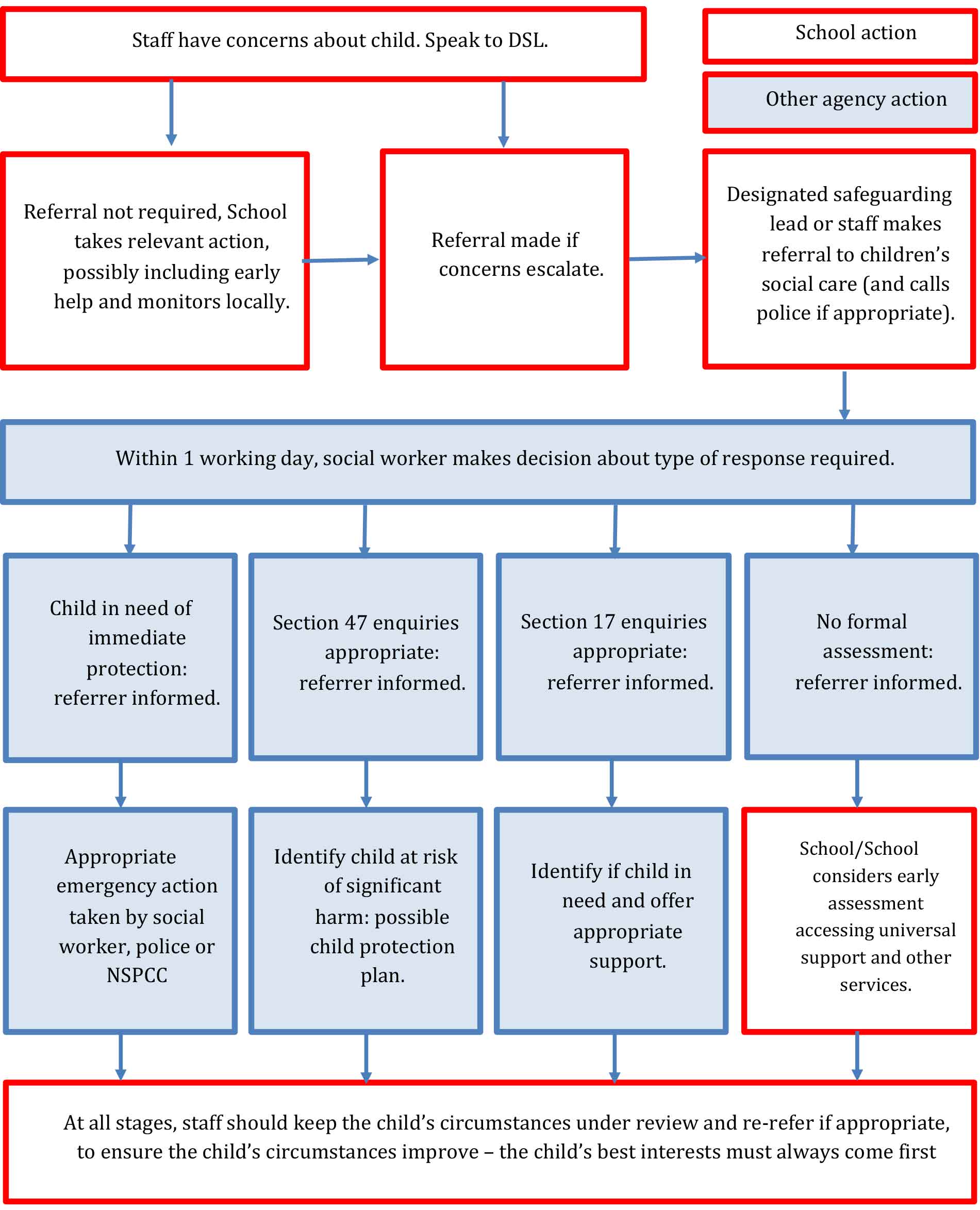

Job description for the Designated Safeguarding Lead (DSL and DDSLs) Updated September 2026
The School is committed to safeguarding and promoting the welfare of children and young people and expects all staff and volunteers to share this commitment
Summary of the role
- To take lead responsibility for safeguarding and child protection (including online safety and understanding the filtering and monitoring systems in place) occurring at the School and to support all other staff in dealing with any child welfare and child protection concerns that arise.
- To provide advice and support to other staff on matters of child welfare, safeguarding and child protection.
- To take part in strategy discussions and inter-agency meetings and to support other staff to do so, and to contribute to the assessment of pupils.
- To promote and safeguard the welfare of pupils in the School.
- Whilst the activities of DSL can be delegated to appropriately trained deputies (DDSLs), the ultimate lead responsibility for child protection remains with the DSL. This lead responsibility cannot be delegated.
Main duties and responsibilities
Further specifics
Availability
You are expected to:
- ensure during term time that you or a Deputy will always be available when the School is open to discuss any safeguarding concerns;
- ensure, in consultation with the Head Teacher, that robust cover arrangements are in place for periods where the DSL is unavailable due to leave, illness or other circumstances so that safeguarding concerns continue to be received, monitored and acted upon without delay; and
- arrange adequate and appropriate cover arrangements for any out-of-hours/out-of-term activities.
Managing referrals
You are expected to refer cases:
- of suspected abuse and neglect of any pupil at the School to the local authority children’s social care and support staff who make referrals to local authority children’s social care;
- to the Channel programme where there is a radicalisation concern and support staff who make referrals to the Channel programme;
- where a person is dismissed or left due to risk/harm to a child to Disclosure and Barring Service (DBS); and
- where a crime has been committed to the Police.
Working with others
You are expected to:
- act as a source of support, advice and expertise for all staff;
- act as a point of contact with the three safeguarding partners: the local authority (Camden); Integrated Care Systems; and the police;
- liaise with the Headteacher to inform them of issues; especially ongoing enquiries under section 47 of the Children Act 1989 and police investigations;
- ensure that an ‘appropriate adult’ is present if a pupil is being questioned or detained by the police;
- as required, liaise with the “case manager” (as per Part 4 of KCSIE) and the designated officer (LADO) at the local authority for child-protection concerns in cases which concern a staff member;
- liaise with staff (especially teachers, pastoral support staff, IT staff, First Aiders, counsellors and the named persons with oversight for SEND) on matters of safety, safeguarding and welfare (including online and digital safety) and when deciding whether to make a referral by liaising with relevant agencies so that children’s needs are considered holistically;
- promote supportive engagement with parents in safeguarding and promoting the welfare of children, including where families may be facing challenging circumstances; and
- work with the Head Teacher and relevant strategic leads, taking lead responsibility for promoting educational outcomes by knowing the welfare, safeguarding and child protection issues that children in need are experiencing, or have experienced, and identifying the impact that these issues might be having on children’s attendance, engagement and achievement at the School. This includes:
- ensuring that the School knows who its cohort of children are who have or have had a social worker, understanding their academic progress and attainment, and maintaining a culture of high aspirations for this cohort; and,
- supporting teaching staff to provide additional academic support or reasonable adjustments to help children who have or have had a social worker reach their potential, recognising that even when statutory social care intervention has ended, there is still a lasting impact on children’s educational outcomes.
Information sharing and managing the child protection files
You are expected to:
- ensure that child protection files are kept up to date.
- ensure that information is kept confidential and stored securely.
- ensure that records include:
- a clear and comprehensive summary of the concern;
- details of how the concern was followed up and resolved; and
- a note of any action taken, decisions reached and the outcome.
- ensure that files are only accessed by those who need to see them and that where the file or content within it is shared, this happens in line with information-sharing advice, as set out in Part 1 and Part 2 of KSCIE.
- ensure, when a pupil leaves the School (including in year transfers), that:
- their child protection file is transferred to the new school or School as soon as possible (within 5 days for an in-year transfer or within the first 5 days of the start of a new term); and
- their child protection file is transferred separately from the pupil’s main file in a secure manner and confirmation of receipt is received from the destination school or School; and
- consider whether it is appropriate to share any information with the new school in advance of the pupil leaving particularly where the information would support an assessment of risk to others in the school as well as the place to help them put in place appropriate support.
Raising awareness
You are expected to:
- ensure each member of staff has access to, and understands, the School’s safeguarding policy and procedures, especially new and part-time staff;
- ensure the School’s safeguarding policy is reviewed annually (as a minimum) and the procedures and implementation are updated and reviewed regularly, and presented to the SLT;
- ensure the safeguarding policy is available publicly and parents know that referrals about suspected abuse or neglect may be made and the role of the School in this;
- link with the safeguarding partner arrangements to make sure staff are aware of any training opportunities and the latest local policies on local safeguarding arrangements; and
- help promote educational outcomes by sharing the information about the welfare, safeguarding and child protection issues that children who have or have had a social worker are experiencing with teachers and School leadership staff.
Training, knowledge and skills
You are expected to ensure your child protection training and that of the DDSLs is sufficient and appropriate to provide the knowledge and skills required to carry out this role. This training must be updated every two years. All members of the DSL team should also undertake Prevent awareness training.
In addition to the formal training, the knowledge and skills of members of the DSL team should be supplemented and refreshed at regular intervals, as required, and at least annually, to allow them to understand and keep up with any developments relevant to their role so that they:
- understand the assessment process for providing early help and statutory intervention, including local criteria for action and local authority children’s social care referral arrangements;
- have a working knowledge of how local authorities conduct a child-protection case conference and a child-protection review conference and be able to attend and contribute to these effectively when required to do so;
- understand the importance of the role the Designated Safeguarding Lead has in providing information and support to children social care in order to safeguard and promote the welfare of children;
- understand the lasting impact that adversity and trauma can have, including on children’s behaviour, mental health and wellbeing, and what is needed in response to this in promoting educational outcomes;
- are alert to the specific needs of children in need, those with Special Educational Needs and Disabilities (SEND), those with relevant health conditions and young carers;
- understand the importance of information sharing, both within the School, and with the three safeguarding partners, other agencies, organisations and practitioners;
- understand and support the School with regards to the requirements of the Prevent duty and be able to provide advice and support to staff on protecting children from the risk of radicalisation;
- are able to understand the unique risks associated with online safety and be confident that they have the relevant knowledge and up to date capability required to keep children safe whilst they are online at School;
- can recognise the additional risks that children with SEN and disabilities (SEND) face online (for example, from online bullying, grooming and radicalisation) and are confident they have the capability to support SEND children to stay safe online;
- obtain access to resources and attend any relevant or refresher training courses; and
- encourage a culture among all staff of listening to pupils and taking account of their wishes and feelings, in any measures the School may put in place to protect them.
Providing support to staff
Training should support the Designated Safeguarding Lead in developing expertise, so they can support and advise staff and help them feel confident on welfare, safeguarding and child-protection matters. This includes, specifically, to:
- ensure that staff are supported during the referrals processes; and
- support staff to consider how safeguarding, welfare and educational outcomes are linked, including to inform the provision of academic and pastoral support.
Understanding the views of children
It is important that children feel heard and understood. Therefore, designated safeguarding leads should be supported in developing knowledge and skills to:
- encourage a culture of listening to children and taking account of their wishes and feelings, among all staff, and in any measures the School may put in place to protect them; and
- understand the difficulties that children may have in approaching staff about their circumstances and consider how to build trusted relationships which facilitate communication.
Holding and sharing information
The critical importance of recording, holding, using and sharing information effectively is set out in Parts 1, 2 and 5 of KCSIE, and therefore members of the DSL team should:
- understand the importance of information sharing, both within the School, and with other schools and Schools on transfer including in-year and between primary and secondary education, and with the safeguarding partners, other agencies, organisations and practitioners;
- understand relevant data-protection legislation and regulations, especially the Data Protection Act 2018 and the General Data Protection Regulation; and
- be able to keep detailed, accurate, secure written records of all concerns, discussions and decisions made including the rationale for those decisions. This should include instances where referrals were or were not made to another agency such as LA children’s social care or the Prevent programme.
Hackett (2010) has proposed a continuum model to demonstrate the range of sexual behaviours presented by children and young people, from those that are normal, to those that are highly deviant.
| Normal | Inappropriate | Problematic | Abusive | Violent |
|---|---|---|---|---|
| Developmentally expected | Single instances of inappropriate sexual behaviour | Problematic and concerning behaviours | Victimising intent or outcome | Physically violent sexual abuse |
| Socially acceptable | Socially acceptable behaviour within peer group | Developmentally unusual and socially unexpected | Includes misuse of power | Highly intrusive |
| Consensual, mutual, reciprocal | Context for behaviour may be inappropriate | No overt elements of victimisation | Coercion and force to ensure victim compliance | Instrumental violence which is physiologically and/ or sexually arousing to the perpetrator |
| Shared decision making | Generally consensual and reciprocal | Consent issues may be unclear | Intrusive | Sadism |
| May lack reciprocity or equal power | Informed consent lacking, or not able to be freely given by victim | |||
| May include levels of compulsivity | May include elements of expressive violence |
Reference: Hackett, S (2010). Children, young people and sexual violence. In Barter, C and Berridge, D (eds) Children behaving badly? Exploring peer violence between children and young people. London: Blackwell Wiley.

